Friday, August 15, 2008

Men of Granite: New Hampshire's Soldiers in the Civil War

by Duane E. Shaffer

From the publisher:
During the Civil War, some thirty-five thousand New Hampshire soldiers--representing approximately 11 percent of the state's population--were dispatched to serve the Union in seventeen infantry regiments, two cavalry regiments, three artillery batteries, and three companies of sharpshooters and as members of miscellaneous naval and marine units. Duane E. Shaffer tells the story of these forces in Men of Granite, a thorough history of New Hampshire combat troops in the years before and during the Civil War. Focusing on the day-to-day experiences of the common soldier and his reasons for taking up the fight against the Confederacy, Shaffer has mined myriad primary sources to draw together the experiences of all of the state's regiments and units into this single, cohesive narrative.

Told in chronological order, Shaffer's narrative follows the experiences of New Hampshire troops, primarily in Virginia and South Carolina. Granite State soldiers were stationed at Hilton Head for much of the war, and they offered vivid accounts of bivouac duty and of inland raids in lowcountry South Carolina. The soldiers also fought in major battles such as Manassas, Antietam, Gettysburg, and Cold Harbor. A chapter each is devoted to the Battle of Fredericksburg in December 1862, a fight that included the largest concentration of New Hampshire soldiers in the war, and the Battle of Chancellorsville in May 1863, in which the Twelfth New Hampshire suffered more casualties than any regiment on either side. Shaffer also details the disaster of the Battle of Fort Wagner in July 1863, in which New Hampshire lost more soldiers than in any other operation. He also follows his subjects' return after the war to recount their homecoming and to cement understanding of their sacrifice.

Further enhanced by twenty illustrations and twelve maps, Shaffer's detailed survey reinserts the story of New Hampshire forces into the annals of Civil War history and, through frequent quotation of soldiers' own accounts, gives voice to the motivations and daily experiences of determined Union forces from the Granite State.

"Focusing primarily on the heroics and hardships of those in uniform, Shaffer has mined a sizable sampling of original diaries and letters to present the most ambitious single-volume account yet of all New Hampshire's Civil War soldiers." -- William Marvel, author of Lincoln's Darkest Year: The War in 1862

Thursday, August 14, 2008

Slavery and Politics in the Early American Republic

by Matthew Mason

From the publisher:
Giving close consideration to previously neglected debates, Matthew Mason challenges the common contention that slavery held little political significance in America until the Missouri Crisis of 1819. Mason demonstrates that slavery and politics were enmeshed in the creation of the nation, and in fact there was never a time between the Revolution and the Civil War in which slavery went uncontested.

The American Revolution set in motion the split between slave states and free states, but Mason explains that the divide took on greater importance in the early nineteenth century. He examines the partisan and geopolitical uses of slavery, the conflicts between free states and their slaveholding neighbors, and the political impact of African Americans across the country.

Offering a full picture of the politics of slavery in the crucial years of the early republic, Mason demonstrates that partisans and patriots, slave and free—and not just abolitionists and advocates of slavery—should be considered important players in the politics of slavery in the United States.

Tuesday, August 12, 2008

The Rifle Musket in Civil War Combat: Reality and Myth

by Earl J. Hess

From the publisher:
The Civil War's single-shot, muzzle-loading musket revolutionized warfare--or so we've been told for years. Noted historian Earl J. Hess forcefully challenges that claim, offering a new, clear-eyed, and convincing assessment of the rifle musket's actual performance on the battlefield and its impact on the course of the Civil War.

Many contemporaries were impressed with the new weapon's increased range of 500 yards, compared to the smoothbore musket's range of 100 yards, and assumed that the rifle was a major factor in prolonging the Civil War. Historians have also assumed that the weapon dramatically increased casualty rates, made decisive victories rare, and relegated cavalry and artillery to far lesser roles than they played in smoothbore battles.

Hess presents a completely new assessment of the rifle musket, contending that its impact was much more limited than previously supposed and was confined primarily to marginal operations such as skirmishing and sniping. He argues further that its potential to alter battle line operations was virtually nullified by inadequate training, soldiers' preference for short-range firing, and the difficulty of seeing the enemy at a distance. He notes that bullets fired from the new musket followed a parabolic trajectory unlike those fired from smoothbores; at mid-range, those rifle balls flew well above the enemy, creating two killing zones between which troops could operate untouched. He also presents the most complete discussion to date of the development of skirmishing and sniping in the Civil War.

Drawing upon the observations and reflections of the soldiers themselves, Hess offers the most compelling argument yet made regarding the actual use of the rifle musket and its influence on Civil War combat. Engagingly written and meticulously researched, his book will be of special interest to Civil War scholars, buffs, re-enactors, and gun enthusiasts alike.

"Hess hits a bull's-eye with this fresh, provocative book."--Daniel Sutherland, author of Seasons of War: The Ordeal of a Confederate Community, 1861-1865

"A most welcome, meticulous, important, and easy-to-read addition to the literature."--Paddy Griffith, author of Battle Tactics of the Civil War

"Should be required reading, not just for students of the U.S. Civil War, but for anyone interested in the history of warfare."--Mark Grimsley, author of And Keep Moving On: The Virginia Campaign, May-June 1864

"A landmark study."--William C. Davis, author of The Cause Lost: Myths and Realities of the Confederacy

Wolf of the Deep: Raphael Semmes and the Notorious Confederate Raider CSS Alabama

by Stephen Fox

From the publisher:
The electrifying story of Raphael Semmes and the CSS Alabama, the Confederate raider that destroyed Union ocean shipping and took more prizes than any other raider in naval history.

In July, 1862, Semmes received orders to take command of a secret new British-built steam warship, the Alabama. At its helm, he would become the most hated and feared man in ports up and down the Union coast—and a Confederate legend. Now, with unparalleled authority and depth, and with a vivid sense of the excitement and danger of the time, Stephen Fox tells the story of Captain Semmes's remarkable wartime exploits. From vicious naval battles off the coast of France, to plundering the cargo of Union ships in the Caribbean, this is a thrilling tale of an often overlooked chapter of the Civil War.

Stephen Fox, an independent historian who did his PhD at Brown University, is the author of six previous books, including Transatlantic, a history of the steamship. He lives near Boston, Massachusetts.

Monday, August 11, 2008

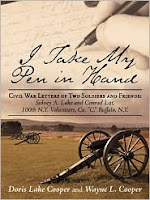
I Take My Pen in Hand: Civil War Letters of Two Soldiers and Friends: Sidney A. Lake and Conrad Litt 100th N. Y. Volunteers Co. C Buffalo N. Y.

by Doris and Wayne L. Cooper

From the publisher:
I Take My Pen in Hand is a collection of Civil War letters written by Sidney A. Lake and Conrad Litt, farm boys and friends from Pembroke, N.Y. These two men served with the 100th N.Y. Volunteer Infantry, 'Eagle Brigade.' Conrad's letters describe the establishment of the regiment in 1862 and several battles, including the Battle of Fair Oaks. The 100th Regiment was in the first charge on Ft. Wagner with other regiments including the 54th Massachusetts (the first Negro regiment). Conrad Litt was killed in this charge on July 18, 1863 at Morris Island, South Carolina.

The letters of Sidney Lake tell of Conrad's death and describe the Battle of Ft. Wagner as well as other major battles. Sidney was discharged in 1865. Sidney's letters tell of events at Ft. Sumter, Bermuda Hundred, tunneling the mine at Petersburg, Virginia and the explosion at City Point, Virginia.

With the addition of 88 descriptive images: which include photographs as well as official records and reports, these letters come alive as we relive this time in history.

From CWBN
This book's exact release date is unknown but falls within this month.

Monday, August 4, 2008

America's Civil War: The Operational Battlefield, 1861-1863

by Brian Holden Reid

From the publisher:
In 1861, when the Confederate States of America seceded from the Union and Civil War broke out between the North and the South, few people had much idea of the scale, intensity, and duration of the conflict they were about to enter. Politicians, generals, and common folk on both sides blithely assumed that the conflict would be over quickly and were naively convinced of the superiority of the leadership and the forces at their disposal. Three years later, after many horrendous battles and huge loss of life, the tragic realities of this war had begun to sink in. Stalemate had led to great frustration and suggested a protracted conflict with no end in sight.

In this successor volume to his acclaimed Origins of the American Civil War (1996), Civil War historian Brian Holden Reid examines in depth the operational military history during the first three years of America's Civil War. In particular, he focuses on generalship, command decisions, strategy, and tactics, as well as the experiences of ordinary soldiers.

Besides lack of experience among generals, Holden Reid reveals that for the first few years of the war there was considerable indecisiveness in the North, a hesitancy to punish the South, and a fruitless hope that the Confederacy would agree to some form of reconciliation. He highlights certain important political and social developments during the course of the war that had an effect on Union soldiers and shows how their views became a catalyst in hardening the attitudes in the North toward the South.

This important analysis makes a major contribution to Civil War military history within the larger context of a turbulent political and social climate. It will be followed by another work covering the final eighteen months of the conflict.

Brian Holden Reid (London, England) is professor of American history and military institutions and head of the Department of War Studies at King's College, London. Since 1993, he has been a member of the Council of the Society for Army Historical Research and from 1998 to 2004 served as chairman. In 2004-2005, he was the first non-American to serve as a member of the Lincoln Prize jury panel, which awards the most important literary prize in the field of Civil War history. His many books include The Origins of the American Civil War, The Civil War and the Wars of the Nineteenth Century, and Robert E. Lee: Icon for a Nation.

Thursday, July 31, 2008

Henry Hotze, Confederate Propagandist: Selected Writings on Revolution, Recognition, and Race

by Lonnie A. Burnett

From the publisher:
An immigrant to Mobile from Switzerland becomes a passionate promoter of the Confederacy

The life of Henry Hotze encompasses the history of antebellum Mobile, Confederate military recruitment, Civil War diplomacy and international intrigue, and the development of a Darwinian-based effort to find scientific evidence for differences among human "races." When civil war broke out in his adopted country, Hotze enthusiastically assumed the mindset of the young Southern secessionist, serving first as newspaper correspondent and Confederate soldier until the Confederate government selected him as an agent, with instructions to promote the Southern cause in London. There he founded, edited, and wrote most of the content for The Index, a pro-Southern paper, as a part of the effort to convince the British Government to extend recognition to the Confederacy.

Among the arguments Hotze employed were adaptations of the scientific racism of the period, which attempted to establish a rational basis for assumptions of racial difference. After the collapse of the Confederacy in 1865, Hotze remained in Europe, where he became an active partisan and promoter of the ideas of Arthur de Gobineau whose work Essai sur L'inegalite des Races Humaines was a founding document in racism's struggle for intellectual respectability.

This work consists of a biographical essay on Hotze; his contributions to Mobile newspapers during his military service in 1861; his correspondence with Confederate officials during his service in London; articles he published in London to influence British and European opinion; and his correspondence with, and published work in support of, Gobineau.

Lonnie A. Burnett is Associate Professor of History at the University of Mobile and author of The Pen Makes a Good Sword: John Forsyth of the Mobile Register.
From CWBN
This book's exact release date is unknown but falls within this month.

The Nebraska-Kansas Act of 1854

by John R. Wunder and Joann M Ross (Editors)

From the publisher:
The Nebraska-Kansas Act of 1854 turns upside down the traditional way of thinking about one of the most important laws ever passed in American history. The act that created Nebraska and Kansas also, in effect, abolished the Missouri Compromise, which had prohibited slavery in the region since 1820. This bow to local control outraged the nation and led to vicious confrontations, including Kansas’s subsequent mini-civil war. The essays in this volume shift the focus from the violent and influential reaction of “Bleeding Kansas” to the role that Nebraska played in this decisive moment.

Essays from both established and new scholars examine the historical context and significance of this statute. They treat American political culture of the 1850s; American territorial history; the roles of Abraham Lincoln, Stephen Douglas, and Frederick Douglass in the creation and implementation of the law; the reactions of African Americans to the act; and the comparative impact on Nebraskans and Kansans. At the 150th anniversary of the Kansas-Nebraska Act, as it came to be known, these scholars reexamine the political, social, and personal contexts of this act and its effect on the course of American history.

John R. Wunder is a professor of history and journalism at the University of Nebraska–Lincoln. He is the author of numerous books, including “Retained by the People”: A History of American Indians and the Bill of Rights, and the coauthor of Americans View Their Dust Bowl Experience.

Joann M. Ross has a JD from the University of Nebraska–Lincoln. She is currently a history instructor at the Louisiana School for Math, Science, and the Arts and is a doctoral candidate in the Department of History at the University of Nebraska–Lincoln.

Contributors include: Nicole Etcheson, Tekla Ali Johnson, Mark E. Neely Jr., Phillip S. Paludan, James A. Rawley, Brenden Rensink, Joann M. Ross, Walter C. Rucker, and John R. Wunder.


From CWBN
This book's exact release date is unknown but falls within this month.

Wednesday, July 30, 2008

REVENUE IMPERATIVE: The Union's Financial Policies During the American Civil War

by Jane Flaherty

From the publisher:
The Revenue Imperative provides a comprehensive overview of the Union financial policies during the American Civil War. Flaherty argues that the revenue imperative, the need to keep pace with the burgeoning expenses of the conflict, governed the development of the fiscal policy. Preserving the nation placed insurmountable strains on the antebellum structure of government, thus forcing a fundamental reorganization of the American financial system. Contingency, rather than a determined effort to implement an ideology or reward special interests, played the pivotal role in the development of the Republican response to financing the war.

The Revenue Imperative closely examines the tariff and internal tax policies inaugurated during the Civil War. Flaherty argues that this new revenue system, more than any other aspect of the war financial policies, changed the relationship between the government and the economy in the post-Civil War era.

Gentlemen Merchants: A Charleston Family's Odyssey, 1828-1870

by Philip N. Racine (Editor)

From the publisher:
Gentlemen Merchants preserves the correspondence between members of two wealthy slaveholding merchant families, the Gourdins and the Youngs in nineteenth-century Charleston, South Carolina. Because the correspondence lasts over forty years, the letters provide a significant record of historical Southern themes. Plantation-born urban dwellers, the correspondents comment deeply and widely on their own family history, religion in the South, slavery and race, business, secession, Civil War, and Reconstruction.

Gentlemen Merchants offers a fresh perspective on the Old South's elite slaveholders from the vantage point of commercial offices, docks, and wharves instead of the rural plantation. These prominent Charleston families grew wealthy through commercial trading of Sea Island and upland cotton, rice, and wine.

Charleston emerges as a main character in these letters as the discrepancy between the wealthy upper class and working-class immigrants becomes more pronounced. There are also letters from family members who traveled widely for business and pleasure. They recount travel adventures in England and France, on the slopes of Mount Vesuvius, and at Niagara Falls.

The Gourdins and Youngs lived in material comfort for over three decades and fought to preserve their way of life, the basis of which was made possible by slavery. The family was one shaped by privilege and destroyed by war. When the world changed as a result of the Civil War, the family members were left penniless.

It is unusual that both sides of this correspondence have survived, making this collection an extraordinary primary source for historical research. Historically minded general readers will also enjoy the perspective on the urban South that these letters provide.

Philip N. Racine published numerous articles and books about southern history, including Piedmont Farmer. He is currently the William R. Kenan Professor of History at Wofford College, where he has taught since 1969.

Monday, July 28, 2008

Sherman's March in Myth and Memory

By Edward Caudill and Paul Ashdown

From the publisher:
"As is often true in our history, the mythology of major events has a history of its own, shaping our visions of the past. Edward Caudill and Paul Ashdown have traced this Civil War scar in Southern memory to its roots in reality, in memoirs, in histories, in the press, and in mythology, basing their story on rich primary sources and portraying events with the same elegant language they have used in other important Civil War interpretative histories." — Donald L. Shaw, University of North Carolina at Chapel Hill

General William Tecumseh Sherman's devastating "March to the Sea" in 1864 burned a swath through the cities and countryside of Georgia and into the history of the American Civil War. As they moved from Atlanta to Savannah-destroying homes, buildings, and crops; killing livestock; and consuming supplies-Sherman and the Union army ignited not only southern property, but also imaginations, in both the North and the South. By the time of the general's death in 1891, when one said "The March," no explanation was required. That remains true today.

Legends and myths about Sherman began forming during the March itself, and took more definitive shape in the industrial age in the late-nineteenth century. Sherman's March in Myth and Memory examines the emergence of various myths surrounding one of the most enduring campaigns in the annals of military history. Edward Caudill and Paul Ashdown provide a brief overview of Sherman's life and his March, but their focus is on how these myths came about-such as one description of a "60-mile wide path of destruction"-and how legends about Sherman and his campaign have served a variety of interests.

Caudill and Ashdown argue that these myths have been employed by groups as disparate as those endorsing the Old South aristocracy and its "Lost Cause," and by others who saw the March as evidence of the superiority of industrialism in modern America over a retreating agrarianism.

Sherman's March in Myth and Memory looks at the general's treatment in the press, among historians, on stage and screen, and in literature, from the time of the March to the present day. The authors show us the many ways in which Sherman has been portrayed in the media and popular culture, and how his devastating March has been stamped into our collective memory.

Edward Caudill and Paul Ashdown are professors of journalism and electronic media at the University of Tennessee. They are co-authors of The Myth of Nathan Bedford Forrest (2005) and The Mosby Myth: A Confederate Hero in Life and Legend (2002). Caudill is author of Darwinian Myths: The Legends and Misuses of a Theory (1997) and co-author of The Scopes Trial: A Photographic History (2000). Ashdown is editor of James Agee: Selected Journalism (1985, 2004) and author of A Cold Mountain Companion (2004).

Monday, July 21, 2008

The Making of a Confederate: Walter Lenoir's Civil War

by William L. Barney

From the publisher:
Despite the advances of the civil rights movement, many white southerners cling to the faded glory of a romanticized Confederate past. In The Making of a Confederate, William L. Barney focuses on the life of one man, Walter Lenoir of North Carolina, to examine the origins of southern white identity alongside its myriad ambiguities and complexities.

Born into a wealthy slaveholding family, Lenoir abhorred the institution, opposed secession, and planned to leave his family to move to Minnesota, in the free North. But when the war erupted in 1860, Lenoir found another escape route--he joined the Confederate army, an experience that would radically transform his ideals. After the war, Lenoir, like many others, embraced the cult of the Lost Cause, refashioning his memory and beliefs in an attempt to make sense of the war, its causes, and its consequences. While some Southerners sank into depression, aligned with the victors, or fiercely opposed the new order, Lenoir withdrew to his acreage in the North Carolina mountains. There, he pursued his own vision of the South's future, one that called for greater self-sufficiency and a more efficient use of the land.

For Lenoir and many fellow Confederates, the war never really ended. As he tells this compelling story, Barney offers new insights into the ways that (selective) memory informs history; through Lenoir's life, readers learn how individual choices can transform abstract historical processes into concrete actions.

"In this fascinating and beautifully written portrait . . . William L. Barney breathes life into many key aspects of the Civil War era as it was experienced in the Upper South. A major achievement." -- Bruce Levine, University of Illinois at Urbana-Champaign, author of Confederate Emancipation: Southern Plans to Free and Arm Slaves during the Civil War

"An enormously intelligent, sensitive, interesting, [and] significant biography of a minor character that takes us inside one white Southerner's life, family, and mind." -- Mina Carson, Oregon State University

Wednesday, July 16, 2008

Lincoln's Darkest Year: The War in 1862

by William Marvel

From the publisher:
A revealing look at Lincoln's actions in 1862—and a nation in the midst of war

Lincoln's Darkest Year offers a gripping narrative of 1862, a pivotal year in our country's Civil War. Marvel continues the story he began in Mr. Lincoln Goes to War, which focused on Lincoln's first year in office, again relying on recently unearthed primary sources and little-known accounts to paint a picture of this critical year in newfound detail. Lincoln's Darkest Year highlights not just the actions but also the deeper motivations of the major figures, including General Ulysses S. Grant, Jefferson Davis, George McClellan, Stonewall Jackson, and, most notably, Lincoln himself. As the action darts from the White House to the battlefields and back, Marvel sheds new light on the hardships endured by everyday citizens and the substantial and sustained public opposition to the war.

The second in a planned four-part series on the Civil War, and the first major reexamination in over fifty years, Lincoln's Darkest Year stands apart from traditional assumptions and narratives about the early years of the Civil War. Marvel combines fluid prose and scholarship with the skills of an investigative historical detective to unearth the true story of our nation's greatest crisis.

William Marvel is the author of "'Mr. Lincoln Goes to War"', "'Lee's Last Retreat"', "'Andersonville"', and several other acclaimed books on the Civil War. He has won a Lincoln Prize, the Douglas Southall Freeman Award, and the Bell Award.

Tuesday, July 8, 2008

The Age of Lincoln

by Orville Vernon Burton

From the publisher:
Stunning in its breadth and conclusions, The Age of Lincoln is a fiercely original history of the five decades that pivoted around the presidency of Abraham Lincoln. Abolishing slavery, the age's most extraordinary accomplishment, was not its most profound. The enduring legacy of the age of Lincoln was inscribing personal liberty into the nation's millennial aspirations.

America has always perceived providence in its progress, but in the 1840s and 1850s pessimism accompanied marked extremism, as Millerites predicted the Second Coming, utopianists planned perfection, Southerners made slavery an inviolable honor, and Northerners conflated Manifest Destiny with free-market opportunity. Even amid historic political compromises the middle ground collapsed. In a remarkable reappraisal of Lincoln, the distinguished historian Orville Vernon Burton shows how the president's authentic Southernness empowered him to conduct a civil war that redefined freedom as a personal right to be expanded to all Americans. In the violent decades to follow, the extent of that freedom would be contested but not its central place in what defined the country.

Presenting a fresh conceptualization of the defining decades of modern America, The Age of Lincoln is narrative history of the highest order.

From CWBN
This is the first paperbak edition of a previously published hardback.

Monday, July 7, 2008

Firebrand of Liberty: The Story of Two Black Regiments that Changed the Course of the Civil War

by Stephen V. Ash

From the publisher:
In March 1863, nine hundred black Union soldiers, led by white officers, invaded Florida and seized the town of Jacksonville. They were among the first African American troops in the Northern army, and their expedition into enemy territory was like no other in the Civil War. It was intended as an assault on slavery by which thousands would be freed.

At the center of the story is prominent abolitionist Colonel Thomas Wentworth Higginson, who led one of the regiments. After waging battle for three weeks, Higginson and his men were mysteriously ordered to withdraw, their mission a seeming failure. Yet their successes in resisting the Confederates and collaborating with white Union forces persuaded President Abraham Lincoln to begin full-scale recruitment of black troops, a momentous decision that helped turned the tide of the war.

Using long-neglected primary sources, historian Stephen V. Ash's stirring narrative re-creates this event with insight, vivid characterizations, and a keen sense of drama. 20 illustrations.

Stephen V. Ash is a professor of history at the University of Tennessee. He is the author of several books on the Civil War, including A Year in the South: Four Lives in 1865. He lives in Knoxville, Tennessee.

Friday, July 4, 2008

Lincoln at Peoria

by Lewis E. Lehrman

From the publisher:
Lincoln at Peoria tells the tale of a hardworking lawyer in Springfield, Illinois at a political turning point. To understand President Abraham Lincoln, one must understand the private citizen who gave the extraordinary antislavery speech at Peoria on October 16, 1854. This three hour address marked the turning point in his political pilgrimage. It dramatically altered the political career of the speaker and, as a result, the history of America.

Lincoln at Peoria examines the seminal Peoria speech and the historical context in which Lincoln delivered it. While some may argue that Lincoln underwent a transformation upon assuming the presidency in1861, the book's author Lewis Lehrman contends, "The great divide between the statecraft of his presidential years and his early legislative years originates with the speech at Peoria in 1854." The book emphasizes the unmistakable wholeness of character, genius, and enterprise to Lincoln s public life from 1854 to 1865. Lincoln s comprehensive antislavery case made at Peoria inspired his subsequent speeches, public letters, and state papers.

The Peoria speech is also Lincoln s primary statement about the nature of early American history and its peculiar institution of slavery. All of his arguments opposed any further extension of slavery in the American republic, founded, as he argued, upon the Declaration of Independence. That all men are created equal, with the inalienable right to liberty, was, for Lincoln, a universal principle that Americans must not ignore. The author of this book insists that Lincoln believed America must get right with the Declaration of Independence. In 1876, the centennial year of the Declaration, the great black abolitionist, Frederick Douglass summarized Lincoln s achievement: "...measuring him by the sentiment of his country, a sentiment he was bound as a statesman to consult, he was swift, zealous, radical, and determined."

Admitted to the Illinois Bar in 1837, having served four terms in the State Legislature and a single term in Congress (1846-1848), Abraham Lincoln had substantially withdrawn from politics between 1849 and 1854. During these five years, his Springfield law practice prospered. Traveling often by horse and buggy, he became a well-respected litigator on the 8th judicial circuit of Illinois.

Then, the Kansas-Nebraska Act, one of the most explosive congressional statutes of American history, burst upon the Illinois prairie with its passage in May of 1854. Sponsored by the famous Illinois Senator Stephen A. Douglas, this legislation repealed the prohibition on slavery in that section of the Louisiana Territory north of the 36 30 parallel a restriction on the spread of slavery agreed by North and South in the Missouri Compromise of 1820. The Kansas-Nebraska Act inaugurated an incendiary chapter in the slavery debates of the early American Republic.

In response to the Kansas-Nebraska Act, Lincoln launched his antislavery campaign. He delivered the substance of his arguments at Springfield on October 4, 1854, for which there are only press reports. A longer version came twelve days later at Peoria. The Springfield remarks did not survive, but by preparing them meticulously for publication, Lincoln made sure the Peoria text endured.

The Peoria address was rigorous, logical, and grounded in thorough historical research marking Lincoln s reentry into politics and his preparation for the presidency in 1861. Lincoln s contemporaries noted that the speech catapulted Lincoln into the national debates over slavery and into national politics for the rest of his life.

Tuesday, July 1, 2008

Rebel: The Life and Times of John Singleton Mosby

by Kevin H. Siepel

From the publisher:
Rebel is the first complete biography of the Confederacy’s best-known partisan commander, John Singleton Mosby, the “Gray Ghost.” A practicing attorney in Virginia and at first a reluctant soldier, in 1861 Mosby took to soldiering with a vengeance, becoming one of the Confederate army’s highest-profile officers, known especially for his cavalry battalion’s continued and effective harassment of Union armies in northern Virginia. Although hunted after the war and regarded, in fact, as the last Confederate officer to surrender, he later became anathema to former Confederates for his willingness to forget the past and his desire to heal the nation’s wounds. Appointed U.S. consul in Hong Kong, he soon initiated an anticorruption campaign that ruined careers in the Far East and Washington. Then, following a stint as a railroad attorney in California, he surfaced again as a government investigator sent by President Theodore Roosevelt to tear down cattlemen’s fences on public lands in the West. Ironically, he ended his career as an attorney in the U.S. Department of Justice.

Siepel has written the fullest biography of Mosby that we are likely to get. The guerrilla warfare is recounted here skillfully. - Washington Post

“[Siepel] has created a truly great historical work on Mosby, a most colorful individual. The book is very well-written and factual, and it easily holds the attention of the reader. Relatively little has been written about Mosby, the man; Siepel has finally given us a comprehensive work that will stand alongside works of other great leaders. Rebel is recommended for both the student of war and politics and for the casual reader.”— Military Review


Kevin H. Siepel is also the author of Joseph Bennett of Evans and the Growing of New York’s Niagara Frontier. Eugene McCarthy (1916–2005) represented Minnesota in both House and Senate and played a key role in the presidential race of 1968. Peter A. Brown is the editor of Take Sides with the Truth: The Postwar Letters of John Singleton Mosby to Samuel F. Chapman. Benjamin Franklin Cooling is the author of a number of books on the Civil War, most recently Counter-Thrust: From the Peninsula to the Antietam (Nebraska 2007).

From CWBN
This is the first paperbak edition of a previously published hardback.

Norton Parker Chipman: A Biography of the Andersonville War Crimes Prosecutor

by Jeffery A. Hogge

From the publisher:
Norton Parker Chipman is best known for successfully prosecuting Henry Wirz, the infamous commander of the Confederacy's Andersonville Prison where more than 13,000 Union soldiers died during the American Civil War. Beyond his involvement in Wirz's trial, Chipman had an almost Forrest Gump-like tendency to naturally appear anywhere important events occurred. He accompanied Abraham Lincoln to Gettysburg and served in the War Department. Later, he represented the District of Columbia as its delegate to Congress and led the fund-raising effort to complete the Washington Monument. After moving to California, he rose to prominence in the state's burgeoning agribusiness and served many years as a Supreme Court commissioner and a Court of Appeal presiding justice. Covering these details and much more, this biography provides intimate glimpses of a Union officer's perspective of the Civil War, a Washington insider's view of the postwar capital and a veteran's influence in shaping and developing California.

Jeffery A. Hogge is a judicial attorney with the California Court of Appeal, Third Appellate District, the court on which Norton Parker Chipman served as presiding justice for the court's first 16 years. He has been a contributing author to legal practice guides and magazines.

Monday, June 30, 2008

August Valentine Kautz, USA: Biography of a Civil War General

by Lawrence G. Kautz

From the publisher:
Born in Germany in 1828, future Union general August Valentine Kautz came to America as an infant. He was privileged to obtain schooling and, after service in the war with Mexico, attended West Point.

Relying heavily on detailed journals kept by Kautz for 43 years, this biography covers his early experiences and his time in the turbulent Pacific Northwest, where he was involved in Indian affairs and the Rogue River War. As with so many American military men of the time, however, the defining event in his career was the Civil War.

Originally assigned to the Western Theater, where he played a role in the capture of Morgan’s Raiders, Kautz’s service included participation in the First Battle of Deep Bottom, the Wilson-Kautz Raid, and the Petersburg assault aimed at capturing Richmond. Kautz has often been misrepresented in historical mentions and this biography seeks to set the record straight. Period photographs and a number of maps are included.

Retired physician Lawrence G. Kautz lives in West Jefferson, North Carolina.

THE TIMBERCLADS IN THE CIVIL WAR: The Lexington, Conestoga and Tyler on the Western Waters

by Myron J. Smith Jr.

From the publisher:
This is the first detailed history of Union warships in the western rivers of the Civil War. The author recounts the exploits of the Lexington, the Conestoga and the Tyler, three steamboats converted to warships that formed the core of the Western Flotilla, from 1861 to 1865. The book focuses on the activities of these three ships while providing context for the greater war, including accounts of these ships’ commanding officers, the development of ironclads and the greater role of the Western Flotilla.

Myron J. Smith, Jr., is the library director and a professor at Tusculum College in Greeneville, Tennessee. He is the author of Le Roy Fitch, (2007) and The Baseball Bibliography, 2d ed., (2006).

Identification Discs Of Union Soldiers In The Civil War: A Complete Classification Guide

by Larry B. Maier and Joseph W. Stahl

From the publisher:
As an iconic symbol of the American GI, the dog tag has gained considerable cultural recognition. This book returns to the origins of the dog tag with an in-depth look at all 49 styles of Civil-War era Union identification discs, including detailed photographs and histories for individual discs as well as a general history of the origin and production of identification discs. This work also provides a general guide to the authentication of identification discs for use by collectors.

Attorney and civil war lecturer Larry B. Maier lives in Ephrata, Pennsylvania. Joseph W. Stahl is a research staff member of the Institute for Defense Analyses. His articles have appeared in the Gettysburg Magazine, Civil War Historian and other publications. He lives in Fairfax, Virginia.

Lee's Bold Plan For Point Lookout: The Rescue of Confederate Prisoners That Never Happened

by Jack E. Schairer

From the publisher
In July 1864, while hemmed in by Grant at Richmond, General Robert E. Lee conceived a bold plan designed not only to relieve Lynchburg and protect the Confederate supply line but also to ultimately make a bold move on Washington itself. A major facet of this plan, with the addition of General Jubal Early's forces, became the rescue of the almost 15,000 Confederate prisoners at Point Lookout, a large Union prison camp at the confluence of the Potomac River and Chesapeake Bay.

This volume takes an in-depth look at Lee's audacious plan, from the circumstances surrounding its inception, simultaneous cavalry and amphibious attacks on Point Lookout, and its somewhat ironic finale. With international recognition hanging in the balance for the Confederacy, the failure of Lee's plan saved the Union and ultimately changed the course of the war. This work focuses on the many factors that contributed to this eventual failure, including Early's somewhat inexplicable hesitancy, a significant loss of time for Confederate troops en route, and aggressive defensive action by Union General Lew Wallace. It also discusses the various circumstances such as Washington's stripped defenses, the potential release of imprisoned Southern troops and a breakdown of Union military intelligence that made Lee's gamble a brilliant, well-founded strategy.

Campaign for Wilson's Creek: The Fight for Missouri Begins

by Jeffrey L. Patrick

From the publisher
In early 1861, most Missourians hoped they could remain neutral in the upcoming conflict between North and South. In fact, a popularly elected state convention voted in March of that year that "no adequate cause" existed to compel Missouri to leave the Union. Instead, Missourians saw themselves as ideologically centered between the radical notions of abolition and secession.

By that summer, however, the situation had deteriorated dramatically. Due to the actions of politicians and soldiers such as Missouri Gov. Claiborne Jackson and Union Gen. Nathaniel Lyon, Missourians found themselves forced to take sides.

Campaign for Wilson's Creek is a fascinating story of high-stakes military gambles, aggressive leadership and lost opportunities. It is also a tale of unique military units, untried but determined commanders, colorful volunteers and professional soldiers. The first major campaign of the Civil War west of the Mississippi River guaranteed that Missourians would be engaged in a long, cruel civil war within the larger, national struggle.
Civil War News

Jeffrey L. Patrick is the National Park Service librarian at Wilson's Creek National Battlefield. He is the author of numerous articles on various aspects of American military history, and is the editor/coeditor of two Civil War diaries. He lives in Republic, Missouri.

Thursday, June 26, 2008

Copperheads

by Jennifer L. Weber

From the publisher:
The Northern home-front during the Civil War was far from tranquil. Fierce political debates set communities on edge, spurred secret plots against the Union, and triggered widespread violence. At the heart of all this turmoil stood the anti-war Democrats, nicknamed "Copperheads."

Now, Jennifer L. Weber offers the first full-length portrait of this powerful faction to appear in almost half a century. Weber reveals how the Copperheads came perilously close to defeating Lincoln and ending the war in the South's favor. Indeed, by the summer of 1864, they had grown so strong that Lincoln himself thought his defeat was "exceedingly likely." Passionate defenders of civil liberties and states' rights--and often virulent racists--the Copperheads deplored Lincoln's suspension of habeas corpus, his liberal interpretation of the Constitution, and, most vehemently, his moves toward emancipation. Weber reveals how the battle over these issues grew so heated that Northerners feared their neighbors would destroy their livestock, burn their homes, even kill them. And she illuminates the role of Union soldiers, who, furious at Copperhead attacks on the war effort, moved firmly
behind Lincoln. The soldiers' support for the embattled president kept him alive politically in his darkest times, and their victories on the battlefield secured his re-election.

Packed with sharp observation and fresh interpretations, Copperheads is a gripping account of the fierce dissent that Lincoln called "the fire in the rear."

Thursday, June 19, 2008

Grant's Lieutenants: From Chattanooga to Appomattox

by Steven E. Woodworth

From the publisher:
A companion to Grant's Lieutenants: From Cairo to Vicksburg, this new volume assesses Union generalship during the final two years of the Civil War. Steven Woodworth, one of the war's premier historians, is joined by a team of distinguished scholars--Mark Grimsley, John Marszalek, and Earl Hess, among others--who critique Ulysses S. Grant's commanders in terms of both their working relationship with their general-in-chief and their actual performances.

The book covers well-known Union field generals like William T. Sherman, George Thomas, George Meade, and Philip Sheridan, as well as the less-prominent Franz Sigel, Horatio Wright, Edward Ord, and Benjamin Butler. In addition, it includes an iconoclastic look at Grant's former superior and wartime chief of staff Henry W. Halleck, focusing on his wise counsel concerning Washington politics, the qualities of various subordinates, and the strategic environment. Each of these probing essays emphasizes the character and accomplishments of a particular general and shows how his relationship with Grant either helped or hindered the Union cause.

The contributors highlight the ways Grant's lieutenants contributed to or challenged their commander's own success and development as a general. In addition to revisiting Grant's key collaboration with Sherman, the essays illuminate the hostile relationship between Grant and Thomas, commander of the Army of the Cumberland; Grant's almost daily contact with "Old Snapping Turtle" Meade, whose expertise relieved Grant of the close tactical direction of the Army of the Potomac; and the development of a highly successful command partnership between Grant and Sheridan, his new commander of the Army of the Shenandoah. Readers will also learn how Grant handled the relative incompetence of his less sterling leaders--perhaps failing to give Butler adequate direction and overlooking Ord's suspect political views in light of their long relationship.

Like its companion volume, Grant's Lieutenants: From Chattanooga to Appomattox is an essential touchstone for Civil War scholars and aficionados. It offers new and profound insights into the command relationships that fundamentally shaped both the conduct of the war and its final outcome.

This book is part of the Modern War Studies series.

"These stimulating and insightful essays remind us of the collaborative nature of military command and help us appreciate how Grant persevered and ultimately prevailed in directing the Union armies to victory." -- Brooks D. Simpson, author of Ulysses S. Grant: Triumph over Adversity, 1822-1865

"A companion to Woodworth's earlier collection of essays on top Union commanders that matches the high quality of the original. . . . Offers incisive analysis of the men Grant entrusted with execution of his strategic plans. Scholars and general readers will find much to ponder in this fine book." -- Gary W. Gallagher, author of The Confederate War

"A fascinating and thought-provoking book." -- Stephen D. Engle, author of Struggle for the Heartland: The Campaigns from Fort Henry to Corinth

Tuesday, June 10, 2008

Desperate Engagement: How a Little-Known Civil War Battle Saved Washington, D.C., and Changed American History

by Marc Leepson

From the publisher:
The Battle of Monocacy, which took place on the blisteringly hot day of July 9, 1864 is one of the Civil War’s most significant yet little-known battles. What played out that day in the corn and wheat fields four miles south of Frederick, Maryland., was a full-field engagement between some 12,000 battle-hardened Confederate troops led by the controversial Jubal Anderson Early, and some 5,800 Union troops, many of them untested in battle, under the mercurial Lew Wallace, the future author of Ben-Hur. When the fighting ended, some 1,300 Union troops were dead, wounded or missing or had been taken prisoner, and Early---who suffered some 800 casualties---had routed Wallace in the northernmost Confederate victory of the war.

Two days later, on another brutally hot afternoon, Monday, July 11, 1864, the foul-mouthed, hard-drinking Early sat astride his horse outside the gates of Fort Stevens in the upper northwestern fringe of Washington, D.C. He was about to make one of the war’s most fateful, portentous decisions: whether or not to order his men to invade the nation’s capital.

Early had been on the march since June 13, when Robert E. Lee ordered him to take an entire corps of men from their Richmond-area encampment and wreak havoc on Yankee troops in the Shenandoah Valley, then to move north and invade Maryland. If Early found the conditions right, Lee said, he was to take the war for the first time into President Lincoln’s front yard. Also on Lee’s agenda: forcing the Yankees to release a good number of troops from the stranglehold that Gen. U.S. Grant had built around Richmond.

Once manned by tens of thousands of experienced troops, Washington’s ring of forts and fortifications that day were in the hands of a ragtag collection of walking wounded Union soldiers, the Veteran Reserve Corps, along with what were known as hundred days’ men--raw recruits who had joined the Union Army to serve as temporary, rear-echelon troops. It was with great shock, then, that the city received news of the impending rebel attack. With near panic filling the streets, Union leaders scrambled to coordinate a force of volunteers.

But Early did not pull the trigger. Because his men were exhausted from the fight at Monocacy and the ensuing march, Early paused before attacking the feebly manned Fort Stevens, giving Grant just enough time to bring thousands of veteran troops up from Richmond. The men arrived at the eleventh hour, just as Early was contemplating whether or not to move into Washington. No invasion was launched, but Early did engage Union forces outside Fort Stevens. During the fighting, President Lincoln paid a visit to the fort, becoming the only sitting president in American history to come under fire in a military engagement.

Historian Marc Leepson shows that had Early arrived in Washington one day earlier, the ensuing havoc easily could have brought about a different conclusion to the war. Leepson uses a vast amount of primary material, including memoirs, official records, newspaper accounts, diary entries and eyewitness reports in a reader-friendly and engaging description of the events surrounding what became known as “the Battle That Saved Washington.”

Journalist and historian Marc Leepson has written for many newspapers and magazines, including Smithsonian, Preservation, The Washington Post, The New York Times, The New York Times Book Review, and Military History. He is a contributor to the Encyclopedia Americana and the Dictionary of Virginia Biography. A former staff writer for Congressional Quarterly, he has been interviewed on The Today Show, CNN, MSNBC, Fox News, All Things Considered, and Morning Edition. He is the author of six books, including Saving Monticello and Flag: An American Biography, and teaches U.S. history at Lord Fairfax Community College in Warrenton, Virginia.

From CWBN:
This is the first softcover edition of a previously released hardback.

The Slaves' War: The Civil War in the Words of Former Slaves

by Andrew Ward

From the publisher:
The first narrative history of the Civil War as told by the very people it freed.

Groundbreaking, compelling, and poignant, The Slaves' War delivers an unprecedented vision of the nation's bloodiest conflict. An acclaimed historian of nineteenth-century and African-American history, Andrew Ward gives us the first narrative of the Civil War told from the perspective of those whose destiny it decided.Woven together from hundreds of interviews, diaries, letters, and memoirs, here is the Civil War as seen not only from battlefields, capitals, and camps, but also from slave quarters, kitchens, roadsides, swamps, and fields. Speaking in a quintessentially American language of biblical power and intensity, body servants, army cooks and launderers, runaways, teamsters, and gravediggers bring the war to richly detailed life. From slaves' theories about the causes of the Civil War to their frank assessments of such major figures as Lincoln, Davis, Lee, and Grant; from their searing memories of the carnage of battle to their often startling attitudes toward masters and liberators alike; and from their initial jubilation at the Yankee invasion of the slave South to the crushing disappointment of freedom's promise unfulfilled, The Slaves' War is a transformative and engrossing vision of America's Second Revolution.

"This is a riveting book about the most important event in our history . . . readable and compelling." --Ken Burns

Tuesday, June 3, 2008

A Southern Moderate in Radical Times: Henry Washington Hilliard, 1808-1892

by David I. Durham

From the publisher:
In A Southern Moderate in Radical Times, David I. Durham offers a comprehensive and critical appraisal of one of the South's famous dissenters. Against the backdrop of one of the most turbulent periods in American history, he explores the ideological and political journey of Henry Washington Hilliard (1808-1892), a southern politician whose opposition to secession placed him at odds with many of his peers in the South's elite class. Durham weaves threads of American legal, social, and diplomatic history to tell the story of this fascinating man who, living during a time of unrestrained destruction as well as seemingly endless possibilities, consistently focused on the positive elements in society even as forces beyond his control shaped his destiny.

A three-term congressman from Alabama, as well as a professor, attorney, diplomat, minister, soldier, and author, Hilliard had a career that spanned more than six decades and involved work on three continents. He modeled himself on the ideal of the erudite statesman and celebrated orator, and strove to maintain that persona throughout his life. As a member of Congress, he strongly opposed secession from the Union. No radical abolitionist, Hilliard supported the constitutional legality of slavery, but working in the tradition of the great moderates, he affirmed the status quo and warned of the dangers of change. For a period of time he and like-minded colleagues were able to successfully overcome the more radical voices and block disunion, but their success was short-lived and eventually overwhelmed by the growing appeal of sectional extremism. As Durham shows, Hilliard's personal suffering, tempered by his consistent faith in Divine Providence, eventually allowed him to return to his ideological roots and find a lasting sense of accomplishment late in life by becoming the unlikely spokesman for the Brazilian antislavery cause.

From Hilliard's literary addresses at South Carolina College and the University of Alabama to his letters and speeches during his tenure in Brazil, Durham reveals an intellectual struggling to understand his world and to reconcile the sphere of the intellectual with that of the church and political interests. A Southern Moderate in Radical Times opens a window into Hilliard's world, and reveals the tragedy of a visionary who understood the dangers lurking in the conflicts he could not control.

David I. Durham is curator of archival collections at the University of Alabama School of Law and teaches in the history department at the University of Alabama.

From CWBN:
The exact day of release for this June title is unknown.

Saturday, May 31, 2008

Awaiting the Heavenly Country: The Civil War and America's Culture of Death

by Mark S. Schantz

From the publisher:
"Americans came to fight the Civil War in the midst of a wider cultural world that sent them messages about death that made it easier to kill and to be killed. They understood that death awaited all who were born and prized the ability to face death with a spirit of calm resignation. They believed that a heavenly eternity of transcendent beauty awaited them beyond the grave. They knew that their heroic achievements would be cherished forever by posterity. They grasped that death itself might be seen as artistically fascinating and even beautiful." -- from Awaiting the Heavenly Country

How much loss can a nation bear? An America in which 620,000 men die at each other's hands in a war at home is almost inconceivable to us now, yet in 1861 American mothers proudly watched their sons, husbands, and fathers go off to war, knowing they would likely be killed. Today, the death of a soldier in Iraq can become headline news; during the Civil War, sometimes families did not learn of their loved ones' deaths until long after the fact.

Did antebellum Americans hold their lives so lightly, or was death so familiar to them that it did not bear avoiding? In Awaiting the Heavenly Country, Mark S. Schantz argues that American attitudes and ideas about death helped facilitate the war's tremendous carnage. Asserting that nineteenth-century attitudes toward death were firmly in place before the war began rather than arising from a sense of resignation after the losses became apparent, Schantz has written a fascinating and chilling narrative of how a society understood death and reckoned the magnitude of destruction it was willing to tolerate.

Schantz addresses topics such as the pervasiveness of death in antebellum America; theological discourse and debate on the nature of heaven and the afterlife; the rural cemetery movement and the inheritance of the Greek revival; death as a major topic in American poetry; African American notions of death, slavery, and citizenship; and a treatment of the art of death--including memorial lithographs, postmortem photography and Rembrandt Peale's major exhibition painting The Court of Death.

Awaiting the Heavenly Country is essential reading for anyone wanting a deeper understanding of the Civil War and the ways in which antebellum Americans comprehended death and the unimaginable bloodshed on the horizon.

"The premise of this very interesting and very satisfying book is that an antebellum American culture of death contributed mightily, even decisively, to the destructive nature of the Civil War. Mark S. Schantz's excellent research melds with his deep knowledge of the war in making persuasive links between antebellum culture and Civil War behaviors--North and South, male and female, black and white, home front and battlefield."--David Waldstreicher, Temple University

"Awaiting the Heavenly Country is an eloquent and insightful analysis of the culture of death and dying in antebellum America. Mark S. Schantz argues that the carnage of the Civil War may perhaps best be explained by a culture that embraced several anesthetizing notions about death: the idea that death was ennobling, that it ushered the deceased into a materially and emotionally rich heavenly existence, that the body itself could be purified and restored in the act of death. Schantz is a generous and sympathetic guide to the mind-numbing bloodletting of the Civil War who manages to explain the inexplicable." -- Susan Juster, University of Michigan

From CWBN:
The exact day of release for this May title is unknown.

Friday, May 30, 2008

Massacre At Bear River: First, Worst and Forgotten

by Rod Miller

From the publisher:
The Bear River Massacre, on January 29, 1863, claimed at least 250 Shoshoni lives. And it changed the culture of the natives who lived in the area along what later became the Utah-Idaho border.

Rod Miller provides a compelling narrative account of the Bear River Massacre and the events leading up to the bloody clash on a frozen riverbank in the foothills of the Rocky Mountains. He gives historical context to three major players in the massacre—the Shoshoni, the military, the Mormon settlers and their leaders—and the interplay among those groups.

Miller also explains why the massacre has remained in the historical shadows for 145 years and details the fight by Shoshonis and a few dedicated researchers to move the event to its rightful place in Western history.

Two Boys in the Civil War: Confederate Brothers During and After the War Between the States

by William Houghton

From the publisher:
Two Boys in the Civil War recounts the war stories of William, an eighteen-year-old schoolteacher at Smith's Station, Alabama, and his brother Mitchell, a sixteen-year-old assistant newspaper editor in Newton, Alabama.

William enlisted in 1861 and was wounded seven times in battle. Mitchell, who also enlisted in 1861, was twice wounded, captured at Lookout Mountain, and imprisoned for sixteen months at Camp Morton, Indiana, where he nearly died from starvation and exposure.

Did Lincoln And The Republican Party Create The Civil War? An Argument

by Robert P. Broadwater

From the publisher:
The author seeks to challenge the long-held perceptions of the politics of the American Civil War. He presents the argument that the Civil War was fought, not to preserve the Union or free the slaves, but rather to establish the political power of the Republican Party within the federal government. The author argues further that Abraham Lincoln and the Republican Party manipulated events to bring about the Civil War in the first place and used the war as a pretext for the establishment of the modern central government.

Robert P. Broadwater has written more than 20 books and more than 100 magazine articles dealing with the Civil War and the Revolution. He is the author of many works on military history including Civil War Medal of Honor Recipients (2007), American Generals of the Revolutionary War (2007), The Battle of Olustee, 1864 (2006), The Battle of Perryville, 1862 (2005) and Chickamauga, Andersonville, Fort Sumter and Guard Duty at Home (2005) and lives in Bellwood, Pennsylvania.

Tuesday, May 27, 2008

Battle: The Nature and Consequences of Civil War

by Kent Gramm

From the publisher:
Romanticism is as rife in Civil War history as any other and may produce more than its share of drums and trumpets writing that glosses over the fear, pain, and death that are inevitable components of all warfare. The essays that make up this collection seek to act as corrective to such celebratory history by carefully examining some of the unpleasant realities that marked combat in the Civil War—when industrial and technological warfare came of age, at a time when medical care, sanitation, diet, and other modern adaptations to industry were still in their infancy.

In addition to an introduction, an afterword, and an essay on the "Numbers" by editor Gramm, Paul Fussell contributes a powerful essay on "The Culture of War"; D. Scott Hartwig examines the face of battle at Gettysburg; Bruce A. Evans discusses "Wounds, Death, and Medical Care in the Civil War"; Eric T. Dean rethinks the meaning and consequences of combat in "The Awful Shock and Rage of Battle"; and Alan T. Nolan looks at the national consequences of battle and the resultant myth of the Lost Cause.

Kent Gramm is Professor of English at Wheaton College, Illinois, and author of November: Lincoln's Elegy at Gettysburg and Somebody's Darling: Essays on the Civil War.

Pursuit

by Clint Johnson

From the publisher:
While much has been written about the hunt for John Wilkes Booth, much less has been written about the efforts to apprehend Confederate President Jefferson Davis in the days following the dissolution of the Confederacy, and the subsequent attempt to try him for treason. In the only book to tell the definitive story of Davis's chase, capture, imprisonment, and release, journalist and Civil War writer Clint Johnson brings this chapter in our nation's history to vivid life, and paints a fascinating portrait of one of American history's most complex and enduring figures.

In the vulnerable weeks following the end of the War and Abraham Lincoln's assassination, some in President Andrew Johnson's administration burned to exact revenge against Davis. Trumping up charges of conspiracy to murder Lincoln and treason against the Union, Secretary of War Edwin Stanton ordered cavalry after Davis. After a chase through North and South Carolina and Georgia, Davis was captured on May 10, 1865. The former United States Senator and Mexican War hero was imprisoned for two years in Fortress Monroe, Virginia, where he was subjected to torture and humiliation-but never brought to trial. Remarkably, the Johnson administration knew Davis was innocent of all crimes before he was even arrested.

With a keen eye for the period's detail, as well as a Southerner's insight, Johnson sheds new light on Davis's time on the run, his treatment while imprisoned, his surprising release from custody, and his eventual exoneration-exposing the powerful political forces involved, and their lasting impact. Johnson draws on extensive official historical documents as well as countless archived private materials such asdiaries, letters, and private papers. With the 200th anniversary of Davis's birth in 2008, the time has never been better for a compelling account of such a defining episode of the Civil War.

Fascinated by the American Civil War since the fourth grade, Clint Johnson has written eight books on the subject, including the acclaimed Civil War Blunders. Originally from Florida, he counts Confederate soldiers from Florida, Georgia, and Alabama among his ancestors. He is active as a Civil War re-enactor and has portrayed soldiers from both the South and the Union. In researching Pursuit, he spent months studying letters, diaries, and the Official Records of the War of the Rebellion. A graduate of the University of Florida with a degree in journalism, he lives in the mountains of North Carolina with his wife, Barbara.

Tuesday, May 20, 2008

The Lincolns: Portrait of a Marriage

by Daniel Mark Epstein

From the publisher:
The first full-length portrait of the marriage of Abraham and Mary Todd Lincoln in more than fifty years, The Lincolns is a fascinating new work of American history by Daniel Mark Epstein, an award-winning biographer and poet known for his passionate understanding of the Civil War period.

Although the private lives of political couples have in our era become front-page news, the true story of this extraordinary and tragic first family has never been fully told. The Lincolns eclipses earlier accounts with riveting new information that makes husband and wife, president and first lady, come alive in all their proud accomplishments and earthy humanity.

Epstein gives a fresh close-up view of the couple’s life in Springfield, Illinois (of their twenty-two years of marriage, all but six were spent there). We witness the troubled courtship of an aristocratic and bewitching Southern belle and a struggling young lawyer who concealed his great ambition with self-deprecating humor; the excitement and confusion of the newlyweds as they begin their marriage in a small room above a tavern, and the early signs of Mary’s instability and Lincoln’s moodiness; their joyful creation of a home on the edge of town as Lincoln builds his law practice and makes his first forays into politics. We discover their consuming ambition as Lincoln achieves celebrity status during his famed debates with Stephen A. Douglas, which lead to Lincoln’s election to the presidency.

The Lincolns’ ascent to the White House brought both dazzling power and the slow, secret unraveling of the couple’s unique bond. The Lincolns dramatizes certain well-known events with stunning new immediacy: Mary’s shopping sprees, her defrauding of the public treasury to increase her budget, and her jealousy, which made enemies for her and problems for the president. Yet she was also a brilliant hostess who transformed the shabby White House into a social center crucial to the Union’s success. After the death of their little boy, not a year after Lincoln took office, Mary turned for solace to spirit mediums, but her grief drove her to the edge of madness. In the end, there was little left of the Lincolns’ relationship save their enduring devotion to each other and to their surviving children.

Written with enormous sweep and striking imagery, The Lincolns is an unforgettable epic set at the center of a crucial American administration. It is also a heartbreaking story of how time and adversity can change people, and of how power corrupts not only morals but affections. Daniel Mark Epstein’s The Lincolns makes two immortal American figures seem as real and human as the rest of us.

“With a novelist’s feel for detail and drama, Daniel Mark Epstein portrays the Lincoln marriage with sensitivity and insight, painting an intimate portrait of a complex and consequential marriage. This work is a splendid addition to the Lincoln literature.” - Doris Kearns Goodwin

“Daniel Epstein in 2004 gave us the best book yet written on Abraham Lincoln and Walt Whitman. Now he has given us the best book yet written on the marriage of Abraham and Mary Lincoln--a comprehensive, sensitive, elegantly wrought masterpiece that puts us up close and personal with one of the most interesting pairings in American history.” - John C. Waugh, author of One Man Great Enough: Abraham Lincoln's Road to Civil War

Lincoln's Assassins: Their Trial and Execution

by James L. Swanson and Daniel Weinberg

From the publisher:
Acclaimed as the definitive illustrated history of Abraham Lincoln's assassination, Lincoln's Assassins, by James L. Swanson and Daniel R. Weinberg, follows the shocking events from the tragic scene at Ford's Theatre to the trial and execution of Booth's co-conspirators. For twelve days after the president was shot, the nation waited breathlessly as manhunters tracked down John Wilkes Booth—the story that was brilliantly told in Swanson's New York Times bestseller, Manhunt. Then, during the spring and summer of 1865, a military commission tried eight people as conspirators in Booth's plot to murder Lincoln and other high officials, including the secretary of state and vice president. Few remember them today, but once the names Mary Surratt, Lewis Powell, David Herold, George Atzerodt, Edman Spangler, Samuel Arnold, Michael O'Laughlin, and Dr. Samuel Mudd were the most reviled and notorious in America.

In Lincoln's Assassins, Swanson and Weinberg resurrect these events by presenting an unprecedented visual record of almost 300 contemporary photographs, letters, documents, prints, woodcuts, newspapers, pamphlets, books, and artifacts, many hitherto unpublished. These rare materials, which took the authors decades to collect, evoke the popular culture of the time, record the origins of the Lincoln myth, take the reader into the courtroom and the cells of the accused, document the beginning of American photojournalism, and memorialize the fates of the eight conspirators.

Lincoln's Assassins is a unique work that will appeal to anyone interested in American history, Abraham Lincoln, the Civil War, law, crime, assassination,nineteenth-century photographic portraiture, and the history of American photojournalism.

James L. Swanson is the author of the New York Times bestseller Manhunt: The 12-Day Chase for Lincoln's Killer. He is an attorney who has written about history, the Constitution, popular culture, and other subjects for a variety of publications, including the Wall Street Journal, American Heritage, Smithsonian, and the Los Angeles Times. Mr. Swanson serves on the advisory council of the Ford's Theatre Abraham Lincoln Bicentennial Campaign and is a member of the advisory committee of the Abraham Lincoln Bicentennial Commission.

The Confederate Army 1861-65: Missouri, Kentucky & Maryland (Men-at-Arms)

by Ron Field, Richard Hook

From the publisher:
Despite the overwhelming image of Confederate soldiers dressed in their drab butternut and gray, the Southern states which formed the Confederacy in 1861 fielded many units of volunteer troops wearing a remarkably wide variety of uniforms, often reflecting foreign influences. In a spirit of independence many states issued their own uniform regulations at the outbreak of the War Between the States and these non-standard uniforms were often retained deep into the war. The regulation patterns centrally prescribed by the Confederate Army were only ever followed unevenly, and state quartermasters continued to issue uniforms showing regional and state differences. This concluding book in a series of six titles studies the archival and pictorial evidence for the infantry, cavalry and artillery of the states that fought for the South even though they never officially seceded—Missouri, Kentucky and Maryland—and is illustrated with fascinating and poignant early photographic portraits.

Ron Field is Head of History at the Cotswold School in Bourton-on-the-Water. He was awarded a Fulbright Scholarship in 1982 and taught history at Piedmont High School in California from 1982 to 1983. He was associate editor of the Confederate Historical Society of Great Britain, from 1983 to 1992. He is an internationally acknowledged expert on US military history, and was elected a Fellow of the Company of Military Historians, based in Washington, DC, in 2005. The author lives in Gloucestershire, UK.

Richard Hook was born in 1938 and trained at Reigate College of Art. After national service with 1st Bn, Queen's Royal Regiment, he became art editor of the much-praised magazine Finding Out during the 1960s. He has worked as a freelance illustrator ever since, earning an international reputation particularly for his deep knowledge of Native American material culture; and has illustrated more than 50 Osprey titles. Richard Hook lives in Sussex, UK.

Monday, May 19, 2008

Abolitionists Remember: Antislavery Autobiographies and the Unfinished Work of Emancipation

by Julie Roy Jeffrey

From the publisher:
In Abolitionists Remember, Julie Roy Jeffrey illuminates a second, little-noted antislavery struggle as abolitionists in the postwar period attempted to counter the nation's growing inclination to forget why the war was fought, what slavery was really like, and why the abolitionist cause was so important.

In the rush to mend fences after the Civil War, the memory of the past faded and turned romantic—slaves became quaint, owners kindly, and the war itself a noble struggle for the Union. Jeffrey examines the autobiographical writings of former abolitionists such as Laura Haviland, Frederick Douglass, Parker Pillsbury, and Samuel J. May, revealing that they wrote not only to counter the popular image of themselves as fanatics, but also to remind readers of the harsh reality of slavery and to advocate equal rights for African Americans in an era of growing racism, Jim Crow, and the Ku Klux Klan. These abolitionists, who went to great lengths to get their accounts published, challenged every important point of the reconciliation narrative, trying to salvage the nobility of their work for emancipation and African Americans and defending their own participation in the great events of their day.

Julie Roy Jeffrey is professor of American history at Goucher College and author of The Great Silent Army of Abolitionism: Ordinary Women in the Abolitionist Movement (from the University of North Carolina Press).

Wade Hampton: Confederate Warrior to Southern Redeemer

by Rod, Jr. Andrew

From the publisher:
Few Southern elites gave more to the Confederate cause or suffered more in its defeat than General Wade Hampton III of South Carolina. One of the South's most illustrious military leaders, Hampton was for a time the commander of all Lee's cavalry and at the end of the war was the highest-ranking Confederate cavalry officer. Yet for all Hampton's military victories, he also suffered devastating losses. He lost a beloved son and a brother, his own home as well as his grandfather's ancestral mansion, and his vast personal fortune. He failed to deter Sherman's legions from capturing his hometown of Columbia and was blamed for the inferno that destroyed it. Previous studies of Hampton have leaned toward hero worship or taken a political approach that considered his personal history irrelevant. Rod Andrew's critical biography demonstrates that Hampton's life is essential to understanding his influence beyond the battlefield and his obsession with vindication for the South.

Andrew's analysis of Hampton sheds light on his critical role during Reconstruction as a conservative white leader, governor, U.S. senator, and Redeemer; his heroic image in the minds of white Southerners; and his positions and apparent contradictions on race and the role of African Americans in the New South. Andrew also shows that Hampton's tragic past explains how he emerged in his own day as a larger-than-life symbol—of national reconciliation as well as Southern defiance.

Rod Andrew Jr. is associate professor of history at Clemson University and a lieutenant colonel in the U.S. Marine Corps Reserve. He is author of Long Gray Lines: The Southern Military School Tradition, 1839-1915 (from the University of North Carolina Press).

Sunday, May 18, 2008

The Union vs. Dr. Mudd

by Hal Higdon

From the publisher:
For nearly 150 years, one question remains unanswered in the events surrounding the assassination of Abraham Lincoln: was Samuel A. Mudd, the physician who set the broken leg of John Wilkes Booth, guilty or innocent of participating in the conspiracy to murder the president?

Featuring a new introduction and epilogue, this well-researched and unbiased account of Mudd's testimony, trial, and imprisonment remains the gold standard on the topic more than forty years after it was first published.

So, did Dr. Mudd merely answer the call of duty when an injured man appeared on his doorstep, or was he a wily co-conspirator who avoided the death penalty? Hal Higdon takes an objective stance and allows the reader to decide.

Hal Higdon is an award-winning author of more than thirty-four books, including the best-seller Marathon: The Ultimate Training Guide and Leopold & Loeb: The Crime of the Century.

From CWBN:
This is a revised softcover edition of a previously released hardback.

Friday, May 16, 2008

Civil War Tales

by Gary C. Walker

From the publisher:
Stories passed down through the generations. Based on long-held family narratives and local folklore, the engaging legends and lore within these pages have not been available to the public before. Developed from hours of personal interviews and research, these accounts are presented in an easy-reading, conversational manner. Relating to the personal lives of many of the generals of the Civil War, this book melds fact with fiction and paints a picture of a time that saw a country divided. Read how Prof. Thomas Jackson became known as "Stonewall" Jackson and how Gen. David Hunter laid waste to the Shenandoah Valley in the spring of 1864, amongst other interesting tales of bravery and hardship during the war.

For over 30 years, Gary C. Walker has written, published, and promoted his books in southern Virginia. He has gathered the stories of the Civil War in that area and has been active in reenactments. Readers have used his books to research family genealogy, write plays, and produce Civil War art. The Virginia Defense Force used the materials to produce a recruitment film.

The Battle of Shiloh and the Organizations Engaged

by D. W. Reed and Timothy B. Smith

From the publisher:
Originally published in 1902 by the Government Printing Office (and revised and reprinted in 1909 and 1913), The Battle of Shiloh and the Organizations Engaged was the official park commission history of this important battle and remains a seminal work on the subject. Although the book is the cornerstone of Shiloh historiography and is extensively cited by serious historians, the original edition is not widely available today. Timothy B. Smith redresses this problem with this new reprint of the 1913 edition for which he has written an introduction that places the important work in historical context.

Written by D. W. Reed, a veteran of the battle and the first official historian of the Shiloh National Military Park, The Battle of Shiloh and the Organizations Engaged provides a succinct and authoritative overview of the battle. In addition to a narrative of the campaign, Reed describes the units engaged and the movements of every brigade. In addition, he includes numerous tables of strengths and losses for the armies as well as remarkably detailed maps and diagrams showing the action as it unfolded. These spectacular color maps are accessible in an enclosed CD in a PDF format. The net result is a compact yet detailed view of Shiloh unmatched anywhere else.

Even a century after its first publication, this book stands as one of the most dependable, concise, and important works on the Battle of Shiloh. This new edition makes this work accessible once again.

D. W. Reed was a veteran of the Battle of Shiloh and the first historian of the Shiloh National Military Park.

Timothy B. Smith is the author of This Great Battlefield of Shiloh: History, Memory, and the Establishment of a Civil War National Military Park and The Untold Story of Shiloh: The Battle and the Battlefield. He was a park ranger at the Shiloh National Military Park before accepting a teaching position at the University of Tennessee at Martin.