Friday, March 21, 2008

Saddle Bag and Spinning Wheel: Being the Civil War Letters of George W. Peddy, MD, Surgeon, 56th Georgia Volunteer Regiment, CSA

by George P. Cuttino

From the publisher:
Much ink and paper have been expended on the Civil War. But most of it has been for the professional observer’s recollections or research results. Even most memoirs are after-the-facts, studied writings, self consciously edited. Here is something different—the as-it-was-happening chronicle of two persons caught up in the events themselves.

Here are 216 letters, the personal correspondence between George Washington Peddy, surgeon, 56th Georgia Volunteer Regiment, CSA., and his wife Kate. More of his letters (166) than hers (50) survived. Nevertheless the chronicle is complete (October 1861–April 1865). The letters were edited by a grandson of the letter writers, Georgie Peddy Cuttino. Cuttino, a professional historian himself, recognized the value of these documents in their original form. The spontaneous intimacy, the grammatical and spelling idiosyncrasies, all in the vernacular of the times, it is all here, unchanged. What results is an unstudied, and consequently genuine and believable, portrayal of life during those trying times. This is the stuff of which real history is made—a chronicle of the unfamous about whom the historian knows so little but would liketo know so much.

GEORGE P. CUTTINO† was a distinguished medieval historian in the department of History at Emory University for thirty two years.

From CWBN:
The publisher describes this new release as "back in print." Amazon shows the release date as March, with no day specified, and the publisher shows it as Spring 2008.

Thursday, March 20, 2008

Gettysburg Heroes: Perfect Soldiers, Hallowed Ground

by Glenn W. LaFantasie

From the publisher:
How Gettysburg shaped the lives of the Civil War generation

"We continually hear that the Gettysburg subject has been exhausted. Glenn LaFantasie proves this wrong. Beautifully written and splendidly researched Gettysburg Heroes is a delight to read." —D. Scott Hartwig

"Gettysburg is more than a pivotal battlefield for Americans. It has also, in its way, become something of a national Pantheon. For American heroes have trod that ground, both those who fought there, and those who came after to learn and remember. Warriors like Generals James Longstreet and Joshua Lawrence Chamberlain, share that field with Abraham Lincoln, Dwight Eisenhower, and Field Marshall Bernard Law Montgomery. In a stimulating series of essays, Glenn LaFantasie looks at all of them in Gettysburg Heroes, examining not only why they came and what they did, but also the impact this hallowed ground had upon them and all Americans." — William C. Davis, author of An Honorable Defeat: The Last Days of the Confederate Government and The Union that Shaped the Confederacy

"Glenn LaFantasie is one of the finest writers in the field of Civil War history. His prose is accessible, pleasurable to read, and always insightful and provocative . . . this book should excite a lot of interest." —Joan Waugh, co-editor of The Memory of the Civil War in American Culture

The Civil War generation saw its world in ways startlingly different from our own. In these essays, Glenn W. LaFantasie examines the lives and experiences of several key personalities who gained fame during the war and after. The battle of Gettysburg is the thread that ties these Civil War lives together. Gettysburg was a personal turning point, though each person was affected differently. Largely biographical in its approach, the book captures the human drama of the war and shows how this group of individuals—including Abraham Lincoln, James Longstreet, Joshua Lawrence Chamberlain, William C. Oates, and others—endured or succumbed to the war and, willingly or unwillingly, influenced its outcome. At the same time, it shows how the war shaped the lives of these individuals, putting them through ordeals they never dreamed they would face or survive.

Glenn W. LaFantasie is Richard Frockt Family Professor of Civil War History at Western Kentucky University. He is author of Twilight at Little Round Top and Gettysburg Requiem: The Life of William C. Oates. He lives in Bowling Green, Kentucky.

From CWBN:
The publisher shows this title as released in January; Barnes & Noble show it still to be released in May; and Amazon shows it released this month with no date specified.

Tuesday, March 18, 2008

America's Civil War: The Operational Battlefield, 1861-1863

by Brian Holden Reid

From the publisher:
In 1861, when the Confederate States of America seceded from the Union and Civil War broke out between the North and the South, few people had much idea of the scale, intensity, and duration of the conflict they were about to enter. Politicians, generals, and common folk on both sides blithely assumed that the conflict would be over quickly and were naively convinced of the superiority of the leadership and the forces at their disposal. Three years later, after many horrendous battles and huge loss of life, the tragic realities of this war had begun to sink in. Stalemate had led to great frustration and suggested a protracted conflict with no end in sight.
In this successor volume to his acclaimed Origins of the American Civil War (1996), Civil War historian Brian Holden Reid examines in depth the operational military history during the first three years of America's Civil War. In particular, he focuses on generalship, command decisions, strategy, and tactics, as well as the experiences of ordinary soldiers.

Besides lack of experience among generals, Holden Reid reveals that for the first few years of the war there was considerable indecisiveness in the North, a hesitancy to punish the South, and a fruitless hope that the Confederacy would agree to some form of reconciliation. He highlights certain important political and social developments during the course of the war that had an effect on Union soldiers and shows how their views became a catalyst in hardening the attitudes in the North toward the South.

This important analysis makes a major contribution to Civil War military history within the larger context of a turbulent political and social climate. It will be followed by another work covering the final eighteen months of the conflict.

Brian Holden Reid (London, England) is professor of American history and military institutions and head of the Department of War Studies at King's College, London. Since 1993, he has been a member of the Council of the Society for Army Historical Research and from 1998 to 2004 served as chairman. In 2004-2005, he was the first non-American to serve as a member of the Lincoln Prize jury panel, which awards the most important literary prize in the field of Civil War history. His many books include The Origins of the American Civil War, The Civil War and the Wars of the Nineteenth Century, and Robert E. Lee: Icon for a Nation.

Saturday, March 15, 2008

Military Records, Pensions Applications, Heirs at Law and Civil War Military Records From the Fauquier County, Virginia Court Minute Books 1840-1904

by Joan W. Peters

From the publisher:
This book presents some of the many types of records that are found in the court minutes. This volume contains those concerned with military affairs of the county, which includes data on men who served in the military.

From CWBN:
This book originally appeared in 1999.

Campaign for Wilson's Creek: The Fight for Missouri Begins

by Jeffrey L. Patrick

From the publisher:
In early 1861, most Missourians hoped they could remain neutral in the upcoming conflict between North and South. In fact, a popularly elected state convention voted in March of that year that "no adequate cause" existed to compel Missouri to leave the Union. Instead, Missourians saw themselves as ideologically centered between the radical notions of abolition and secession.

By that summer, however, the situation had deteriorated dramatically. Due to the actions of politicians and soldiers such as Missouri Gov. Claiborne Jackson and Union Gen. Nathaniel Lyon, Missourians found themselves forced to take sides.

Campaign for Wilson's Creek is a fascinating story of high-stakes military gambles, aggressive leadership and lost opportunities. It is also a tale of unique military units, untried but determined commanders, colorful volunteers and professional soldiers. The first major campaign of the Civil War west of the Mississippi River guaranteed that Missourians would be engaged in a long, cruel civil war within the larger, national struggle.

Jeffrey L. Patrick is the National Park Service librarian at Wilson's Creek National Battlefield. He is the author of numerous articles on various aspects of American military history, and is the editor/coeditor of two Civil War diaries. He lives in Republic, Missouri.

Nevada Civil War Claims: Legislative Reports, 1888-1900

by Diane E Greene

From the publisher:
This excellent resource book contains facsimile reprints of legislative reports submitted to the Senate and the House of Representatives for Nevada Civil War claims between April 16, 1888 and May 16, 1900. The reports are a goldmine of information, liberally peppered with the names of persons and places. Reports are written in a narrative style and offer a richly detailed explanation of conditions and events related to "the suppression of the rebellion." Reports concern: persons reimbursed for money expended during "the Indian war in 1860 in what was then western Utah, now Nevada;" claims of the state of Nevada "for the general defense and in furnishing troops to the United States during the suppression of the war of the rebellion, and for guarding the overland mail and emigrant route between the Missouri River and California, and for suppressing Indian hostilities;" money expended by California, Oregon, and Nevada "to assist in guarding the overland mail and emigrant routes, in preventing Indian outbreaks in the States, and to aid the United States in various ways during the war of the rebellion;" and war claims of California, Oregon, and Nevada-"the larger portions of the claims of these States are for extra pay and bounty paid by them during the war of the rebellion." Numerous tables and lists are included in these reports.

Friday, March 14, 2008

On Sherman's Trail: The Civil War's North Carolina Climax

by Jim Wise

From the publisher:
Join journalist and historian Jim Wise as he follows Sherman's last march through the Tar Heel State from Wilson's Store to the surrender at Bennett Place. Retrace the steps of the soldiers at Averasboro and Bentonville. Learn about what the civilians faced as the Northern army approached and view the modern landscape through their eyes. Whether you are on the road or in a comfortable armchair, you will enjoy this memorable, well-researched account of General Sherman's North Carolina campaign and the brave men and women who stood in his path.

The Civil War in Loudoun County, Virginia: A History of Hard Times

by Stevan F. Meserve

From the publisher:
In this look at Loudoun County's role in the Civil War, historian Stevan Meserve narrates not only the large-scale fighting at Ball's Bluff in 1861 and in the Loudoun Valley cavalry battles of 1863, but also the lives of the citizens who sacrificed their crops and livestock, cared for the wounded and buried the dead of storied regiments such as White's Comanches, Cole's Potomac Home Brigade, Mosby's Rangers and the Independent Loudoun Rangers.

Drawing upon military accounts and other historical documents, The Civil War in Loudoun County celebrates their eventual triumph and the vibrant communities that exist today.

Thursday, March 13, 2008

The Lincoln-Douglas Debates of 1858

by James L. Huston (Author), Robert W. Johannsen (Editor)

2008 marks the 150th Anniversary of the most famous political debate in U.S. history. Oxford is pleased to present Robert W. Johannsen's newly revised and thoroughly edited transcript of The Lincoln-Douglas Debates. Framed by a timely and relevant new introduction by James L. Huston, this series of debates between Abraham Lincoln and Stephen A. Douglas communicates the eloquence, urgency, and immediacy of its historical moment. As Lincoln and Douglas fiercely competed for the Illinois seat in the U.S. Senate, they debated many of the crucial and controversial issues--including slavery--that would later come to define Lincoln's political career. This invaluable resource also includes Douglas's Chicago speech and Lincoln's "House Divided" speech. With updated notes and suggestions for further reading, the new edition of The Lincoln-Douglas Debates continues to be the authoritative presentation of these lively, landmark orations.

Robert W. Johannsen is J. G. Randall Distinguished Professor of History Emeritus at the University of Illinois. He is the author of Stephen A. Douglas (OUP, 1973; Francis Parkman Prize); To the Halls of the Montezumas: The Mexican War in the American Imagination (OUP, 1985); The Frontier, the Union, and Stephen A. Douglas; and Lincoln, the South, and Slavery: The Political Dimension.

Tuesday, March 11, 2008

What This Cruel War Was over: Soldiers, Slavery, and the Civil War

by Chandra Manning

From the publisher:
A vivid, unprecedented account of why Union and Confederate soldiers identified slavery as the root of the war, how the conflict changed troops’ ideas about slavery, and what those changing ideas meant for the war and the nation.

Using soldiers’ letters, diaries, and regimental newspapers, Chandra Manning allows us to accompany soldiers—black and white, northern and southern—into camps and hospitals and on marches and battlefields to better understand their thoughts about what they were doing and why. Manning’s work reveals that Union soldiers, though evincing little sympathy for abolitionism before the war, were calling for emancipation by the second half of 1861, ahead of civilians, political leaders, and officers, and a full year before the Emancipation Proclamation. She recognizes Confederate soldiers’ primary focus on their own families, and explores how their beliefs about abolition—that it would endanger their loved ones, erase the privileges of white manhood, and destroy the very fabric of southern society—motivated even non-slaveholding Confederates to fight and compelled them to persevere through military catastrophes like Gettysburg and Atlanta, long after they grew to despise the Confederate government and disdain the southern citizenry. She makes clear that while white Union troops viewed preservation of the Union as essential to the legacy of the Revolution, over the course of the war many also came to think that in order to gain God’s favor, they and other white northerners must confront the racial prejudices that made them complicit in the sin of slavery. We see how the eventual consideration of theenlistment of black soldiers by the Confederacy eliminated any reason for many Confederate soldiers to fight; how, by 1865, black Union soldiers believed the forward racial strides made during the war would continue; and how white Union troops’ commitment to racial change, fluctuating with the progress of the war, created undreamt-of potential for change but failed to fulfill it.

An important and eye-opening addition to our understanding of the Civil War.

Chandra Manning, a graduate of Mount Holyoke College, received an M.Phil from the National University of Ireland, Galway, and took her Ph.D. at Harvard in 2002. She has lectured in history at Harvard and taught at Pacific Lutheran University in Tacoma, Washington. Currently, she is assistant professor of history at Georgetown University and lives in Alexandria, Virginia, with her husband and son. This is her first book.

From the critics:
For this impressively researched Civil War social history, Georgetown assistant history professor Manning visited more than two dozen states to comb though archives and libraries for primary source material, mostly diaries and letters of men who fought on both sides in the Civil War, along with more than 100 regimental newspapers. The result is an engagingly written, convincingly argued social history with a point—that those who did the fighting in the Union and Confederate armies "plainly identified slavery as the root of the Civil War." - Publisher's Weekly

From CWBN:
This is the first paperback edition of a hardcover book.

Monday, March 10, 2008

Jewel of Liberty: Abraham Lincoln's Re-election and the End of Slavery

by David E. Long

From the publisher:
The Jewel of Liberty marks a milestone in Civil War and Lincoln history, combining in-depth research with challenging new arguments to present the case for the election of 1864--which returned Lincoln to office to continue the war and cemented emancipation--as the most important in American history. Had Lincoln lost, the Confederacy might have achieved its two main goals: independence as a nation and the perpetuation of slavery. Never in our past has the nature and future of the nation depended so much on the ballot box.

David E. Long holds J.D. and Ph.D. degrees and is a professor of history at East Carolina University. His articles have appeared in Civil War Times Illustrated, Journal of Southern History, and other publications. In 2001 he provided commentary for the PBS miniseries Abraham and Mary Lincoln.

From the publisher:
This splendid book is the best account of Northern politics during the Civil War to hae appeared in years. -- James M. McPherson, Pulitzer Prize-winning author of Battle Day of Freedom

The Jewel of Liberty is the most important study of Lincoln and the Civil War to appear in more than a decade. -- Stephen B. Oates, author of Abraham Lincoln

Friday, March 7, 2008

Roll Call to Destiny: The Soldier's Eye View of Civil War Battles

by Brent Nosworthy

From CWBN:
Roll Call to Destiny puts readers on the frontlines of the Civil War by providing the point of view of small bands of men who braved unique combat situations. Acclaimed military historian Brent Nosworthy answers such questions as what it was like for artillery to beat back an aggressive infantry assault or to take part in a fast-paced cavalry charge, and how Civil War infantry conflict was waged in thick, forest foliage. From firsthand accounts, Nosworthy has pieced together Burnside's infantry at Bull Run (infantry-versus-infantry on the open field), the Fifty-Seventh New York at Fair Oaks (fighting in the woods), Daniel Webster's section at Arkansas Post (artillery attacking a fort), the third day at Gettysburg (cavalry-versus-cavalry), plus much more.

A must-read for anyone who wants to know what Confederate and Union soldiers saw, heard, and felt, as well as how they acted at critical moments of the Civil War.

From CWBN:
The exact day of release for this March title is unknown.

Thursday, March 6, 2008

The Encyclopedia of Civil War Medicine

by Glenna R. Schroeder-Lein

From the publisher:
The story of Civil War medicine--the staggering challenge of treating wounds and disease on both sides of the conflict--is one of the most compelling aspects of the war. Written for general readers and scholars alike, this first-of-its kind encyclopedia will help all Civil War enthusiasts to better understand this amazing medical saga.

Clearly organized, authoritative, and readable, The Encyclopedia of Civil War Medicine covers both traditional historical subjects and medical details. It offers clear explanations of unfamiliar medical terms, diseases, wounds, and treatments. The encyclopedia depicts notable medical personalities, generals with notorious wounds, soldiers' aid societies, medical department structure, and hospital design and function. It highlights the battles with the greatest medical significance, women's medical roles, period sanitation issues, and much more.

Presented in A-Z format with more than 200 entries, the encyclopedia treats both Union and Confederate material in a balanced way. Its many user-friendly features include a chronology, a glossary, cross-references, and a bibliography for further study.

From CWBN:
The exact day of release for this March title is unknown.

Wednesday, March 5, 2008

Lincoln and the Speeds

by Bryan S. Bush

From the publisher:
This book is a dual biography of Joshua and James Speed and tells the story of how closely the friendship between Joshua Speed and Abraham Lincoln continued to affect not only Joshua Speed’s life, but also the life of his brother James Speed. Both Joshua and James were dedicated to the Union, even though they followed different paths. James was a Unionist, emancipationist, abolitionist, and Radical Republican. He entered politics, becoming a state representative and later Attorney-General under Abraham Lincoln and later Andrew Johnson.

Joshua Speed lived his life as a businessman. He differed from his brother and Lincoln on the subject of emancipation, but felt that the issue should not hinder his support of the Union. In April of 1861 after the attack on Fort Sumter, the citizens of Kentucky debated the issue of whether to join the Union or Confederacy. Because of Joshua and James Speed’s loyalty to the Union, Lincoln depended on the brothers to help secure Kentucky for the Union. With their help, Lincoln managed to transport thousands of weapons into Kentucky for distribution among the loyal Union Home Guard.

During the war Lincoln needed trustworthy friends to help him deal with the delicate situation in Kentucky. James and Joshua Speed kept him informed on both the political and the civilian affairs. After Lincoln’s death, James and Joshua helped to preserve his legacy in their individual ways. James became a Radical Republican and fought to gain equality under the law for blacks, even though most of Kentucky did not want to follow the Radial Republican stance on reconstruction. Joshua helped to maintain Lincoln’s legacy by contributing to Lincoln’s memorial and speaking and writing about him.

With the 200th anniversary of Lincoln’s birth, the story of Joshua and James Speed can give the reader another window into his friendships. The story of Joshua and James Speed can also reveal information about Kentucky politics during the Civil War; the struggle between Union loyalists and Confederate sympathizers, and the struggle for emancipation, abolition, and those who opposed equal rights for blacks in Kentucky.

From CWBN:
The exact day of release for this March title is unknown.

Tuesday, March 4, 2008

The Day Freedom Died: The Colfax Massacre, the Supreme Court, and the Betrayal of Reconstruction

by Charles Lane

From the publisher:
The untold story of the slaying of a Southern town’s ex-slaves and a white lawyer’s historic battle to bring the perpretators to justice

Following the Civil War, Colfax, Louisiana, was a town, like many, where African Americans and whites mingled uneasily. But on April 13, 1873, a small army of white ex–Confederate soldiers, enraged after attempts by freedmen to assert their new rights, killed more than sixty African Americans who had occupied a courthouse. With skill and tenacity, The Washington Post’s Charles Lane transforms this nearly forgotten incident into a riveting historical saga.

Seeking justice for the slain, one brave U.S. attorney, James Beckwith, risked his life and career to investigate and punish the perpetrators—but they all went free. What followed was a series of courtroom dramas that culminated at the Supreme Court, where the justices’ verdict compromised the victories of the Civil War and left Southern blacks at the mercy of violent whites for generations. The Day Freedom Died is an electrifying piece of historical detective work that captures a gallery of characters from presidents to townspeople, and re-creates the bloody days of Reconstruction, when the often brutal struggle for equality moved from the battlefield into communities across the nation.

“One of the most memorable opening lines in English literature, from Ford Maddox Ford's novel The Good Soldier, is: ‘This is the saddest story I have ever heard.’ That could be the epigraph for Charles Lane's shattering account of the post-Civil War betrayal of African Americans and the bloody collapse of Reconstruction.” — George F. Will

"A highly impressive, deeply researched, engagingly written account of one of the lowest chapters in U.S. Supreme Court history." — David J. Garrow, author of Bearing the Cross

Saturday, March 1, 2008

The Untold Story of Shiloh: The Battle and the Battlefield

by Timothy B. Smith

From the publisher:
At the mention of Shiloh, most tend to think of two particularly bloody and crucial days in April 1862. The complete story, however, encompasses much more history than that of the battle itself. While several accounts have taken a comprehensive approach to Shiloh, significant gaps still remain in the collective understanding of the battle and battlefield.

In The Untold Story of Shiloh, Timothy B. Smith fills in those gaps, looking beyond two days of battle and offering unique insight into the history of unexplored periods and topics concerning the Battle of Shiloh and the Shiloh National Military Park.

This collection of essays, some previously unpublished, tackles a diverse range of subjects, including Shiloh's historiography, the myths about the battle that were created, and the mindsets that were established after the battle. The book reveals neglected military aspects of the battle, such as the naval contribution, the climax of the Shiloh campaign at Corinth, and the soldiers' views of the battle. The essays also focus on the Shiloh National Military Park's establishment and continuation with particular emphasis on those who played key roles in its creation.

Taken together, the essays tell the overall story of Shiloh in greater detail than ever before. General readers and historians alike will discover that The Untold Story of Shiloh is an important contribution to their understanding of this crucial episode in the Civil War.

Timothy B. Smith is on staff at the Shiloh National Military Park. He is author of Champion Hill: Decisive Battle for Vicksburg and This Great Battlefield of Shiloh: History, Memory, and the Establishment of a Civil War National Military Park.

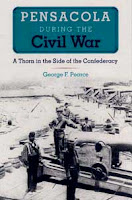
Pensacola during the Civil War: A Thorn in the Side of the Confederacy

by George F. Pearce

From the publisher:
"A pathbreaking study of one of the forgotten enclaves of the Civil War. . . . [It] opens new understanding of the role of Fort Pickens and Pensacola and the onset of the Civil War." -- B. F. Cooling, author of Forts Henry and Donelson: Key to the Confederate Heartland

Well before the outbreak of the Civil War, both North and South recognized the strategic importance of Pensacola, Florida’s largest city in 1861. Bruce Catton has characterized nearby Fort Pickens, on the northwestern Gulf Coast, as "a case that was fully as explosive as that of Fort Sumter." Until this new work by George Pearce, however, historians have neglected Pensacola’s role in the secession crisis and the conflict that ensued.

This straightforward narrative account begins with the secession movement and the Fort Pickens truce, then follows the course of events in this forgotten corner of the war. From the secessionist capture of Pensacola's navy yard and hospital and Forts Barrancas and McRee in February 1861, to Bragg’s failed raid on Fort Pickens, to the operations of the East and West Gulf Blockading Squadrons creating unrest along the coast, Pearce follows the actions by which the Union denied Confederate resupply by sea and tied down a considerable Confederate force that was increasingly needed elsewhere. He details Union cavalry raids as far north as Alabama, which disrupted vital rail transportation between Mississippi and Georgia, and the defeat of the Confederates at Blakely, which forced the surrender of Mobile.

Pearce also follows the impact of the war on Pensacola itself. Coping with white refugees, freed slaves, scorched-earth evacuations, raiding and foraging by the military, and the constant presence of Union and Confederate troops led to the abandonment of the city. By July 1863, a once vibrant population had dwindled to 72 whites and 10 blacks, and the scars of conflict gave this antebellum metropolis a ghostly appearance.

Illustrated with maps and period photos and drawings, this first examination of Pensacola's forgotten role in the Civil War will appeal to both Civil War buffs and those interested in the history of the Gulf Coast from Pensacola to the Rio Grande.

George F. Pearce, professor emeritus of history at the University of West Florida in Pensacola, is the author of The U.S. Navy in Pensacola: From Sailing Ships to Naval Aviation, 1825-1930 (UPF, 1980).

Soldier Boy: The Civil War Letters of Charles O. Musser, 29th Iowa

by Barry Popchock

From the publisher:
Blood and anger, bragging and pain, are all part of this young Iowa soldier's vigorous words about war and soldiering. A twenty-year-old farmer from Council Bluffs, Charles O. Musser was one of the 76,000 Iowans who enlisted to wear the blue uniform. He was a prolific writer, penning at least 130 letters home during his term of service with the 29th Iowa Volunteer Infantry.

Soldier Boy makes a significant contribution to the literature of the common soldier in the Civil War. Moreover, it takes a rare look at the Trans-Mississippi theater, which has traditionally been undervalued by historians.

Always Musser dutifully wrote and mailed his letters home. With a commendable eye for historical detail, he told of battles and marches, guerrilla and siege warfare, camp life and garrison soldiering, morale and patriotism, Copperheads and contraband, and Lincoln's reelection and assassination, creating a remarkable account of activities in this almost forgotten backwater of the war.

Raising Freedom's Child: Black Children and Visions of the Future After Slavery

by Mary Mitchell

From CWBN:
”Mitchell's sophisticated, nuanced reading of a wealth of previously untapped documents and period photographs casts a dazzling fresh light on the way that abolitionists, educators, missionaries, planters, politicians, and free children of color envisioned the status of African Americans after emancipation.” — Steven Mintz, University of Houston

“Raising Freedom’s Child demonstrates the importance of childhood studies for understanding the nation’s political, economic, and social history. In this carefully researched book, Mitchell keeps the black child at the center of the struggle to define freedom in the aftermath of Civil War and emancipation.” — Marie Jenkins Schwartz, University of Rhode Island

The end of slavery in the United States inspired conflicting visions of the future for all Americans in the nineteenth century, black and white, slave and free. The black child became a figure upon which people projected their hopes and fears about slavery’s abolition. As a member of the first generation of African Americans to grow up in freedom, the black child — freedom’s child — connoted a future where African Americans might enjoy the same privileges as whites: landownership, equality, autonomy. Yet this image was a nightmare for most white southerners. Even many northerners expressed doubts about the consequences of abolition for the nation and its identity as a “white” republic.

From the 1850s and the Civil War to emancipation and the official end of Reconstruction in 1877, Raising Freedom’s Child examines slave emancipation and opposition to it as a far-reaching, national event with profound social, political, and cultural consequences. Mary Niall Mitchell analyzes a dizzying array of representations of the black child—letters, photographs, newspaper columns, court cases, and more—to illustrate how Americans contested and defended slavery, tracing sharp debates over black children’s education, labor, racial classification, and citizenship. Only with the triumph of segregation in public schools in 1877 did the black child lose its public role in the national struggle over civil rights, a role it would not play again until the 1950s.

Friday, February 29, 2008

Vital Rails: The Charleston & Savannah Railroad and the Civil War in Coastal South Carolina

by H. David, Jr. Stone

From the publisher:
Completed in 1860 and spanning more than one hundred miles across rice fields, salt marshes, and seven rivers and creeks, the Charleston & Savannah Railroad was designed to revolutionize the economy of South Carolina's lowcountry by linking key port cities. With the onset of the Civil War, the railroad became an integral part of the Confederacy's military, economic, and communications efforts along the coast and a frequent military objective of Union assaults. In Vital Rails, H. David Stone, Jr., provides the first detailed recounting of the C&S line's history and of the railroad's valuable role in the Civil War.

Originally conceived as a means to stave off commercial isolation in Charleston and Savannah by placing the cities on the shortest trade route between the Northeast and the Gulf Coast, the C&S was chartered by a coalition of lowcountry planters, merchants, and politicians. Construction was aided by state government funding and completed by crews of slaves just prior to the onset of war. Following the Union capture of Port Royal in November 1861, the railroad's importance became not only economic but also logistical as a communications line and troop transport for the Confederacy. From November 1861 to March 1862, while commanding coastal forces, General Robert E. Lee supervised construction of the line's fortifications and situated his headquarters near it at Coosawhatchie in Beaufort District.

The railroad was essential in containing Union attacks on Charleston after the capture of Beaufort. In total the C&S was the objective of eight battles and skirmishes with Union forces--including the Battles of Pocotaligo in May and October of 1862 and the Battle of Honey Hill in November 1864. It was not until General William T. Sherman's army took Savannah in December 1864 that the Union forces had the strength to mount a successful campaign against the railroad.

Left in financial ruin after the war, the C&S faced a series of bankruptcies before its route's eventual incorporation into one of the most important commercial transportation arteries on the eastern seaboard, the Plant System, later the Atlantic Coast Line, the Seaboard Coast Line, and finally CSX Transportation. In mapping this first full history of the railroad, Stone has arduously sifted through company records, annual reports, and other public and private documents to record fully the story of the C&S and of the men--including William J. Magrath, R. L. Singletary, and Henry S. Haines--who managed it during wartime with resourcefulness and a strong sense of their role in defending South Carolina.

Vital Rails is an excellent study that expertly connects the importance of the Charleston & Savannah Railroad to the Confederacy's overall war effort. Rich with detailed information, maps, and images, Stone's book is a must-read for all those interested in truly understanding the crucial logistical and military operations in the South Carolina lowcountry during the Civil War.--Stephen R. Wise, curator, Parris Island Museum, and author of Gate of Hell: Campaign for Charleston Harbor, 1863

H. David Stone breaks new ground in his thoughtful study of the Charleston & Savannah Railroad. The C&S's conception, construction, Civil War operations, and economic collapse at the end of the war describe in microcosm antebellum southern railroad development. The Confederate defense of the railroad against Union raiders offers new insights into this nearly forgotten aspect of the Civil War. A well-researched history, Vital Rails should attract the interest of economic, military, railroad, and southern historians as well as those interested in the histories of Charleston and Savannah.--John E. Clark, Jr., author of Railroads in the Civil War: The Impact of Management on Victory and Defeat


From CWBN:
Highly recommended. Stone's pours Civil War history and railroad history into a narrative mold, adding plenty of detail for buffs of both camps. Guaranteed to improve your understanding of the role of rail power in the ACW.

Slavery, Capitalism and Politics in the Antebellum Republic: Volume 2, The Coming of the Civil War, 1850-1861

by John Ashworth

From the publisher:
This book asks why the United States experienced a civil war in 1861 and analyses the descent into war in the final decade of peace. The book systematically surveys southern extremists, Republicans, Democrats, Whigs, temperance advocates and Know Nothings. It advances a new and unique explanation of the origins of the Civil War, the most important event in the history of the most powerful country in the world.

John Ashworth was born in Lancashire, England, and studied at the Universities of Lancaster and Oxford. He is currently Professor of American History in the School of American and Canadian Studies at the University of Nottingham. Professor Ashworth is the author of 'Agrarians' and 'Aristocrats': Party Political Ideology in the United States, 1837-1846, of Slavery, Capitalism and Politics in the Antebellum Republic: Volume 1: Commerce and Compromise, 1820-1850 (both of which were published by Cambridge University Press), and of numerous articles and reviews in learned journals.

Two Boys in the Civil War: Confederate Brothers During and After the War Between the States

by William Houghton

From the publisher:
Two Boys in the Civil War recounts the war stories of William, an eighteen-year-old schoolteacher at Smith's Station, Alabama, and his brother Mitchell, a sixteen-year-old assistant newspaper editor in Newton, Alabama.

William enlisted in 1861 and was wounded seven times in battle. Mitchell, who also enlisted in 1861, was twice wounded, captured at Lookout Mountain, and imprisoned for sixteen months at Camp Morton, Indiana, where he nearly died from starvation and exposure.

A Soldier to the Last: Maj. Gen. Joseph Wheeler in Blue and Gray

by Edward G. Longacre

From the publisher:
Maj. Gen. Joseph Wheeler served in two armies, playing a major role in the development of Confederate cavalry in the Civil War's western theater, and, more than thirty years afterwards, commanded troops in the Spanish-American War. After leaving the U.S. Army to join the Confederacy, Wheeler served in artillery and infantry units before joining the cavalry. Subsequently, he fought at Shiloh, the Battle of Murfreesboro, and other engagements. As a cavalry commander in the Army of Tennessee from mid-1862 almost to the war's end, he raided Gen. William T. Sherman's lines of communication and contested his advance in the final Carolinas campaign.

In addition to detailing Wheeler's Civil War experience, Edward Longacre discusses Wheeler's youth and education at West Point, his pre-Civil War service in the Regiment of Mounted Riflemen, his postwar business, his political career as a congressman from Alabama, and his colorful service in Cuba as a major general of volunteers during the Spanish-American War. Longacre also seeks to correct errors and misconceptions about this Civil War figure that have become a part of the public record, making Joseph Wheeler's life and career accessible to a new generation of readers. A Soldier to the Last will be a valuable addition to the library of anyone interested in Civil War history and U.S. military history.

Appalachian Ohio and the Civil War, 1862–1863

by Susan G. Hall

From the publisher:
The antebellum culture of Harrison County (birthplace of George Armstrong Custer) and the surrounding five-county area of Appalachian east Ohio was an outspoken, democratic society—and a way station of the Underground Railroad for escaping slaves. With the coming of the War Between the States, this community faced momentous change and bitter divisions. Its politicians stumped for and against the conflict; its farmboys, carpenters, scholars and ministers marched off to Kentucky, Mississippi, Virginia, and Tennessee, there to become hardened soldiers laying destruction about them, even as a powerful Copperhead peace movement grew at home. The area was menaced by John Hunt Morgan’s Confederate Cavalry.

This narrative history of the crucial year of this area’s real involvement in the war, from summer to summer, provides a portrait of the area’s Scotch-Irish, followed by German and English, traditions and culture, and the ways in which the war affected everyone, young women left without husbands and whole families plagued by far-away diseases brought home. Letters and diaries from the soldiers and those who loved them provide insight into their thoughts and feelings, as well as their reactions to the very different cultures (women in white dresses had not been seen before) they experienced. Also included are illustrations and maps that display both the Harrison County area and the battlefields where many of her sons saw combat.

Former college professor Susan G. Halllives in Louisville, Kentucky. In addition to writing on Appalachia and the Civil War, she coedited the Encyclopedia of American Icons.

The Antietam Campaign

by Gary W. Gallagher

From the publisher:
The Maryland campaign of September 1862 ranks among the most important military operations of the American Civil War. Crucial political, diplomatic, and military issues were at stake as Robert E. Lee and George B. McClellan maneuvered and fought in the western part of the state. The climactic clash came on September 17 at the battle of Antietam, where more than 23,000 men fell in the single bloodiest day of the war. The essays in this volume address a range of topics related to Lee's and McClellan's operations. Approaching their subjects from a variety of perspectives, contributors explore questions regarding military leadership, strategy, and tactics, the impact of the fighting on officers and soldiers in both armies, and the ways in which participants and people behind the lines reacted to, interpreted, and remembered the campaign. The contributors are William A. Blair, Keith S. Bohannon, Peter S. Carmichael, Gary W. Gallagher, Lesley J. Gordon, D. Scott Hartwig, Robert E. L. Krick, Robert K. Krick, Carol Reardon, and Brooks D. Simpson.

From CWBN:
This is the paperback release of a previously published hardback title.

Wednesday, February 27, 2008

Manhood and Patriotic Awakening in the American Civil War: The John E. Mattoon Letters, 1859-1866

by Robert Donald

From the publisher:
It has been over sixty years since the first book that tried to explain the life and lot of the common soldier in the American Civil War was published. Since Bell Wiley's Life of Johnny Reb (1943), there have been many thousands of pages devoted to the troops and the social history underlying the conflict of the Civil War. Within that historical record, one question still captivates and provokes: why did they fight?

John E. Mattoon was certainly one such "common" soldier, aside from his uncommonly interesting and expressive letters. This book constitutes a valuable case study illuminating the motives, experiences, and ultimate realizations of a young cavalry volunteer. The exploration of John's personal motivations and the actions of his peers adds further clarity to our body of knowledge, which may force us to reassess some preconceived notions about the prototypical Union soldier. Scholarly research adds historical context to provide colorful depth and flesh to a developing interpretation of John's experiences. A refreshing approach to an old conflict-students, teachers, and anyone interested in the personal side of war will benefit from the firsthand glimpse of Manhood and Patriotic Awakening.

Robert Bruce Donald is a graduate of Middlebury College in Vermont and earned his Master's Degree in History from Trinity College (Hartford). He has worked in finance and marketing, then as a consultant producing a multitude of documents over many years. But it is a life-long interest in the study of history that has happily produced this book.

Tuesday, February 26, 2008

Dispatches for the New York Tribune: Selected Journalism of Karl Marx

by Karl Marx

From the publisher:
A compelling, wide-ranging collection of Karl Marx's journalism—available only from Penguin Classics

Karl Marx is arguably the most famous political philosopher of all time, but he was also one of the great foreign correspondents of the nineteenth century. Drawing on his eleven-year tenure at the New York Tribune (which began in 1852), this completely new collection presents Marx's writings on an abundance of topics, from issues of class and state to world affairs. Particularly moving pieces highlight social inequality and starvation in Britain, while others explore his groundbreaking views on the slave and opium trades. Throughout, Marx's fresh perspective on nineteenth-century events reveals a social consciousness that remains inspiring to this day.

Monday, February 25, 2008

Freedom for Themselves: North Carolina's Black Soldiers in the Civil War Era

by Richard M. Reid

From the publisher:
More than 5,000 North Carolina slaves escaped from their white owners to serve in the Union army during the Civil War. In Freedom for Themselves Richard Reid explores the stories of black soldiers from four regiments raised in North Carolina. Constructing a multidimensional portrait of the soldiers and their families, he provides a new understanding of the spectrum of black experience during and after the war.

Reid examines the processes by which black men enlisted and were trained, the history of each regiment, the lives of the soldiers' families during the war, and the postwar experiences of the veterans and their families living in an ex-Confederate state. By considering four regiments from a single state, Reid presents a cross section of a wide range of experiences and assesses what experiences proved largely universal among black troops. The full freedom they fought for and dreamed of having when the war ended did not materialize in their lifetimes, but Reid shows that many of them found in the army a kind of equality that was denied them in civilian life. The postwar benefits afforded to white veterans seldom crossed the color line. The accolades African American soldiers received, Reid demonstrates, came not from a new southern society, but from within their own communities, where black soldiers were seen and recognized as heroes.

The Civil War in Loudoun County, Virginia: A History of Hard Times

by Stevan F. Meserve

From the publisher:
In this look at Loudoun County's role in the Civil War, historian Stevan Meserve narrates not only the large-scale fighting at Ball's Bluff in 1861 and in the Loudoun Valley cavalry battles of 1863, but also the lives of the citizens who sacrificed their crops and livestock, cared for the wounded and buried the dead of storied regiments such as White's Comanches, Cole's Potomac Home Brigade, Mosby's Rangers and the Independent Loudoun Rangers. Drawing upon military accounts and other historical documents, The Civil War in Loudoun County celebrates their eventual triumph and the vibrant communities that exist today.

From CWBN:
Barnes& Noble shows the release date for this title as today; Amazon shows it as March 14.

The Battle of Belmont: Grant Strikes South

by Nathaniel Cheairs Hughes

From the publisher:
The battle of Belmont was the first battle in the western theater of the Civil War and, more importantly, the first battle of the war fought by Ulysses S. Grant. It set a pattern for warfare not only in the Mississippi Valley but at Fort Donelson and Shiloh as well. Grant's 7 November 1861 strike against the Southern forces at Belmont, in southeastern Missouri on the Mississippi River, made use of the newly outfitted Yankee timberclads and all the infantry available at the staging area in Cairo, Illinois.

The Confederates, led by Leonidas Polk and Gideon Pillow, had the advantages of position and superior numbers. They hoped to smash Grant's expeditionary force on the Missouri shore and cut off the escape of the Illinois and Iowa troops from their boats. The confrontation was a bloody, all-day fight that a veteran of a dozen major battles would later call "frightful to contemplate." At first successful, the Federals were eventually driven from the field and withdrew up the Mississippi to safety. The battle cost some twenty percent of his troops, but as a result of this engagement he became known as an audacious fighting general.

Using diaries and letters of participants, official documents, and contemporary newspaper accounts, Nathaniel Hughes provides the only full-length tactical study of the battle that catapulted Grant into prominence. Throughout the narrative, Hughes draws sketches of the lives and fates of individual soldiers who fought on both sides, especially of the colorful and enormously dissimilar principal actors, Grant and Polk.

Fredericksburg Campaign: Decision on the Rappahannock

by Gary W. Gallagher

From the publisher:
"It is well this is so terrible! We should grow too fond of it," said General Robert E. Lee as he watched his troops repulse the Union attack at Fredericksburg on 13 December 1863.

This collection of seven original essays by leading Civil War historians reinterprets the bloody Fredericksburg campaign and places it within a broader social and political context. By analyzing the battle's antecedents as well as its aftermath, the contributors challenge some long-held assumptions about the engagement and clarify our picture of the war as a whole. The book begins with revisionist assessments of the leadership of Ambrose Burnside and Robert E. Lee and features a portrait of the conduct and attitudes of one group of northern troops who participated in the failed assaults at Marye's Heights. Other essays examine how both armies reacted to the battle and how the northern and southern homefronts responded to news of the carnage at Fredericksburg. A final chapter explores the impact of the battle on the residents of the Fredericksburg area and assesses changing Union attitudes about the treatment of Confederate civilians.

Wednesday, February 20, 2008

On Sherman's Trail: The Civil War's North Carolina Climax

by Jim Wise

From CWBN:
We were unable to find any description of this book on the publisher's website or on the sites of booksellers Amazon and Barnes & Noble.

There is also a discrepancy in publication date, with B&N showing a February 16 release, Amazon showing a March 14 release, and the publisher's site making no mention of the title at all.

Friday, February 15, 2008

Stonewall Brigade in the Civil War

by Steve Smith

From the publisher:
This book is about the First Virginia--Thomas J. “Stonewall” Jackson’s Brigade--through the Civil War, with order of battle charts, technical specifications of weapons, profiles of commanders, and illustrations.

Steve Smith started out in military publishing more than 20 years ago and his career has included work as author, editor, and publisher. He founded the military history publishing company Sarpedon, and has written many books on 20th century military topics under his own name—most recently 2nd Armored Division: Hell on Wheels—and Civil War titles under a pseudonym. He is currently managing editor for a military history publishing company.

Lincoln and the Court

by Brian McGinty

In a meticulously researched and engagingly written narrative, Brian McGinty rescues the story of Abraham Lincoln and the Supreme Court from long and undeserved neglect, recounting the compelling history of the Civil War president's relations with the nation's highest tribunal and the role it played in resolving the agonizing issues raised by the conflict.

Lincoln was, more than any other president in the nation's history, a "lawyerly" president, the veteran of thousands of courtroom battles, where victories were won, not by raw strength or superior numbers, but by appeals to reason, citations of precedent, and invocations of justice. He brought his nearly twenty-five years of experience as a practicing lawyer to bear on his presidential duties to nominate Supreme Court justices, preside over a major reorganization of the federal court system, and respond to Supreme Court decisions--some of which gravely threatened the Union cause.

The Civil War was, on one level, a struggle between competing visions of constitutional law, represented on the one side by Lincoln's insistence that the United States was a permanent Union of one people united by a "supreme law," and on the other by Jefferson Davis's argument that the United States was a compact of sovereign states whose legal ties could be dissolved at any time and for any reason, subject only to the judgment of the dissolving states that the cause for dissolution was sufficient. Alternately opposed and supported by the justices of the Supreme Court, Lincoln steered the war-torn nation on a sometimes uncertain, but ultimately triumphant, path to victory, saving the Union, freeing the slaves, and preserving the Constitution for future generations.

From the critics:
McGinty's engaging account, which treats a topic with obvious parallels to the present, will delight history buffs. - Publishers Weekly

A Soldier to the Last: Maj. Gen. Joseph Wheeler in Blue and Gray

by Edwad G. Longacre

From the publisher:
Maj. Gen. Joseph Wheeler served in two armies, playing a major role in the development of Confederate cavalry in the Civil War's western theater, and, more than thirty years afterwards, commanded troops in the Spanish-American War. After leaving the U.S. Army to join the Confederacy, Wheeler served in artillery and infantry units before joining the cavalry. Subsequently, he fought at Shiloh, the Battle of Murfreesboro, and other engagements. As a cavalry commander in the Army of Tennessee from mid-1862 almost to the war's end, he raided Gen. William T. Sherman's lines of communication and contested his advance in the final Carolinas campaign.

In addition to detailing Wheeler's Civil War experience, Edward Longacre discusses Wheeler's youth and education at West Point, his pre-Civil War service in the Regiment of Mounted Riflemen, his postwar business, his political career as a congressman from Alabama, and his colorful service in Cuba as a major general of volunteers during the Spanish-American War. Longacre also seeks to correct errors and misconceptions about this Civil War figure that have become a part of the public record, making Joseph Wheeler's life and career accessible to a new generation of readers. A Soldier to the Last will be a valuable addition to the library of anyone interested in Civil War history and U.S. military history.

Big Enough to Be Inconsistent: Abraham Lincoln Confronts Slavery and Race

by George M. Fredrickson

From the publisher:
“Cruel, merciful; peace-loving, a fighter; despising Negroes and letting them fight and vote; protecting slavery and freeing slaves.” Abraham Lincoln was, W. E. B. Du Bois declared, “big enough to be inconsistent.” Big enough, indeed, for every generation to have its own Lincoln—unifier or emancipator, egalitarian or racist. In an effort to reconcile these views, and to offer a more complex and nuanced account of a figure so central to American history, this book focuses on the most controversial aspect of Lincoln’s thought and politics—his attitudes and actions regarding slavery and race. Drawing attention to the limitations of Lincoln’s judgment and policies without denying his magnitude, the book provides the most comprehensive and even-handed account available of Lincoln’s contradictory treatment of black Americans in matters of slavery in the South and basic civil rights in the North.

George Fredrickson shows how Lincoln’s antislavery convictions, however genuine and strong, were held in check by an equally strong commitment to the rights of the states and the limitations of federal power. He explores how Lincoln’s beliefs about racial equality in civil rights, stirred and strengthened by the African American contribution to the northern war effort, were countered by his conservative constitutional philosophy, which left this matter to the states. The Lincoln who emerges from these pages is far more comprehensible and credible in his inconsistencies, and in the abiding beliefs and evolving principles from which they arose. Deeply principled but nonetheless flawed, all-too-human yet undeniably heroic, he is a Lincoln for all generations.

Thursday, February 14, 2008

The Rescue of Joshua Glover: A Fugitive Slave, the Constitution, and the Coming of the Civil War

by H. Robert Baker

From the publisher:

On March 11, 1854, the people of Wisconsin prevented agents of the federal government from carrying away the fugitive slave, Joshua Glover. Assembling in mass outside the Milwaukee courthouse, they demanded that the federal officers respect his civil liberties as they would those of any other citizen of the state. When the officers refused, the crowd took matters into its own hands and rescued Joshua Glover.

The federal government brought his rescuers to trial, but the Wisconsin Supreme Court intervened and took the bold step of ruling the Fugitive Slave Act unconstitutional.

The Rescue of Joshua Glover delves into the courtroom trials, political battles, and cultural equivocation precipitated by Joshua Glover's brief, but enormously important, appearance in Wisconsin on the eve of the Civil War. H. Robert Baker articulates the many ways in which this case evoked powerful emotions in antebellum America, just as the stage adaptation of Uncle Tom's Cabin was touring the country and stirring antislavery sentiments. Terribly conflicted about race, Americans struggled mightily with a revolutionary heritage that sanctified liberty but also brooked compromise with slavery. Nevertheless, as the Rescue of Joshua Glover demonstrates, they maintained the principle that the people themselves were the last defenders of constitutional liberty, even as Glover's rescue raised troubling questions about citizenship and the place of free blacks in America.

H. Robert Baker is a visiting assistant professor in history at Marquette University.

Tuesday, February 12, 2008

California Gold Rush and the Coming of the Civil War

by Leonard L. Richards

From the publisher:
It has always been understood that the 1848 discovery of gold in the foothills of the Sierra Nevada influenced the battle over the admission of California to the Union. But now, in this revelatory study, award-winning historian Leonard L. Richards makes clear the links between the Gold Rush and many of the regional crises in the lead-up to the Civil War.

Richards explains how Southerners envisioned California as a new market for slaves and saw themselves importing their own slaves to dig for gold, only to be frustrated by California’s passage of a state constitution that prohibited slavery. Still, they schemed to tie California to the South with a southern-routed transcontinental railroad and worked to split off the southern half as a separate slave state.

We see how the Gold Rush influenced the squabbling over the Gadsden Purchase, the Kansas-Nebraska Act, the repeal of the Missouri Compromise, and various attempts to take Cuba and Nicaragua. We meet David Broderick, a renegade New York Democrat who became a force in San Francisco politics in 1849, and his archrival William Gwin, a major Mississippi slaveholder and politician who arrived in California with the intent of making it a slave state and himself one of its first senators. Richards recounts the Washington battles involving Taylor, Clay, Calhoun, Douglas, Davis, Webster, Fillmore, and others, as well as the fiery California political battles, feuds, duels, and perhaps outright murder as the state came shockingly close to being divided in two.

When war did break out efforts were made to push California to secede, but there was little general enthusiasm for secession, and many prominent Southerners wentoff to join the Confederate Army. And with the South out of the Union, the Pacific Railroad Act passed, insuring a comfortably northern route.

The Lincoln-Douglas Debates of 1858

by James L. Huston (Author), Robert W. Johannsen (Editor)

From the publisher:
2008 marks the 150th Anniversary of the most famous political debate in U.S. history. Oxford is pleased to present Robert W. Johannsen's newly revised and thoroughly edited transcript of The Lincoln-Douglas Debates. Framed by a timely and relevant new introduction by James L. Huston, this series of debates between Abraham Lincoln and Stephen A. Douglas communicates the eloquence, urgency, and immediacy of its historical moment. As Lincoln and Douglas fiercely competed for the Illinois seat in the U.S. Senate, they debated many of the crucial and controversial issues--including slavery--that would later come to define Lincoln's political career. This invaluable resource also includes Douglas's Chicago speech and Lincoln's "House Divided" speech. With updated notes and suggestions for further reading, the new edition of The Lincoln-Douglas Debates continues to be the authoritative presentation of these lively, landmark orations.

Robert W. Johannsen is J. G. Randall Distinguished Professor of History Emeritus at the University of Illinois. He is the author of Stephen A. Douglas (OUP, 1973; Francis Parkman Prize); To the Halls of the Montezumas: The Mexican War in the American Imagination (OUP, 1985); The Frontier, the Union,and Stephen A. Douglas; and Lincoln, the South, and Slavery: The Political Dimension.

Monday, February 11, 2008

The Civil War and Reconstruction: A Documentary Reader

by Stanley Harrold

From the publisher:
This volume deals with two momentous and interrelated events in American history. The American Civil War is the country's largest and most significant war, as northern victory created national sovereignty and ended legal slavery. Reconstruction, although intricately linked to the Civil War, has a more complicated and darker legacy. During this era, the U.S. government undertook a limited effort in behalf of black citizenship, and--faced with violent resistance from white southerners--abandoned the effort. Emancipated and enfranchised after the Civil War, African Americans contributed to the economic, social, and political Reconstruction of the South only to see their efforts come to an end due to southern white resistance and northern indifference.

This reader provides students with a collection of more than sixty essential documentary sources for these periods, including presidential addresses, official reports, songs and poems, and a variety of eyewitness testimony concerning significant (and often dramatic) events. Contextualizing headnotes explain the importance of each document.

Harrold's introduction includes an explanation of how historians analyze, contextualize, and interpret a variety of primary sources related to the Civil War and Reconstruction, allowing students to acquire a better understanding of the raw materials with which historians create narratives of the past, and making this volume a valuable supplement to a variety of courses.

Saturday, February 9, 2008

Two Brothers - One North, One South

by David H. Jones

From the publisher:
Walt Whitman feared that the real war would never get in the books: the true stories that depicted the courage and humanity of soldiers who fought, bled, and died in the American Civil War.

Exceptionally researched and keenly accurate to actual events, along with the personages that forged them, David H. Jones's novel spans four years in the midst of America s costliest and most commemorated war. The journey is navigated by the poet, Walt Whitman, whose documented compassion for the wounded and dying soldiers of the war takes him to Armory Square Hospital in Washington, D.C., and finds him at the bedside of William Prentiss, a Rebel soldier, just after fighting has ended.

As fate has it, William's brother, Clifton, a Union officer, is being treated in another ward of the same hospital, and Whitman becomes the sole link not just between the two, but with the rest of their family as well. The reader is taken seamlessly from Medfield Academy in Baltimore, where the Prentiss family makes its home, to the many battlefields where North and South collide, and even through the drawing rooms of wartime Richmond, where Hetty, Jenny, and Constance Cary are the reigning belles.

The author, David H. Jones, born and raised in West Virginia, has been a lifelong student of the Civil War. His research took him into the swamps of Dinwiddie County, Virginia, to rediscover the lost location where a pivotal event in the book took place. A graduate of Kentucky Military Institute and Babson College, former Navy officer, and entrepreneur, he currently lives and writes in Los Angeles, California.

From CWBN:
We missed the true release date for this title, February 1.

Thursday, February 7, 2008

The Civil War 100

by Michael L. Lanning

From the publisher:
The Civil War was the defining event in American history.
The Civil War 100 uses a truly novel approach to analyze the respective importance of the events, leaders and battles of America's most important war.

"Across this easily accessible reference, readers meet not only such icons as Lincoln and Lee, but also chronic fumblers whose tarnished reputations have most often sunk beneath the notice of the endless waves of Civil War histories. A recommended reference for the aficionado and the uninitiated alike. Those well-versed in Civil War lore will enjoy the intellectual challenge of supporting or debunking Lanning's rankings, while the merely curious will be exposed to an insightful world of detail that they may have otherwise missed." -ForeWord Magazine

Michael Lee Lanning retired from the U.S. Army after more than twenty years of service. He is a decorated veteran of the Vietnam War, where he served as an infantry platoon leader and company commander. Lanning has written fourteen books on military history, including The Battle 100. He lives in Phoenix, Arizona.

From CWBN:
The exact day of release for this February title is unknown.

Wednesday, February 6, 2008

Planting the Union Flag in Texas: The Campaigns of Major General Nathaniel P. Banks in the West

by Stephen A. Dupree

From the publisher:
Appointed by President Lincoln to command the Gulf Department in November 1862, Nathaniel Prentice Banks was given three assignments, one of which was to occupy some point in Texas. He was told that when he united his army with Grant's, he would assume command of both. Banks, then, had the opportunity to become the leading general in the West—perhaps the most important general in the war. But he squandered what successes he had, never rendezvoused with Grant's army, and ultimately orchestrated some of the greatest military blunders of the war. "Banks's faults as a general," writes author Stephen A. Dupree, "were legion."

The originality of Planting the Union Flag in Texas lies not just in the author's description of the battles and campaigns Banks led, nor in his recognition of the character traits that underlay Banks's decisions. Rather, it lies in how Dupree synthesizes his studies of Banks's various actions during his tour of duty in and near Texas to help the reader understand them as a unified campaign. He skillfully weaves together Banks's various attempts to gain Union control of Texas with his other activities and shines the light of Banks's character on the resulting events to help explain both their potential and their shortcomings.

In the end, readers will have a holistic understanding of Banks's "appalling" failure to win Texas and may even be led to ask how the post–Civil War era might have been different had he been successful. This fine study will appeal to Civil War buffs and fans of military and Texas history.

STEPHEN A. DUPREE is retired from Sandia National Laboratories, where he served as an expert in nuclear nonproliferation, international safeguards, and the detection and analysis of nuclear radiation. A lifelong interest in the Civil War, especially actions in the Southwest, led to the research for this book. Dupree holds a Ph.D. in nuclear engineering from Purdue University. He lives in Rio Rancho, New Mexico.

From CWBN:
The exact day of release for this February title is unknown.

Tuesday, February 5, 2008

Abraham Lincoln, A Man of Faith and Courage: Stories of Our Most Admired President

by Joe L. Wheeler

From the publisher:
Undoubtedly the most revered leader in American history, Abraham Lincoln has had more books written about him than all ournation's presidents put together. But for all that's been written,little has focused on his faith and how this quality shaped the man who led our country during its most tumultuous years.

Author Joe Wheeler, historian and scholar, brings to the pages of this insightful book the knowledge gleaned from over ten years of study and more than sixty books on the life and times of Abraham Lincoln. Skillfully weaving his own narrative with direct quotes from Lincoln and poignant excerpts from other Lincoln biographers, Wheeler brings a refreshingly friendly rendition of Lincoln's life, faith, and courage.

The stories, historical details, and powerful quotes on the pages of this book will leave a lasting impression on your heart, your mind, and your life.

From CWBN:
This title is shown release on 29 January by Amazon and February 5th by Barnes & Noble. B&N show it published by Simon and Schuster; Amazon shows it published by the Howard Press.

The Gettysburg Diaries: War Journals of Two American Adversaries

by Mark Nesbitt

From CWBN:
We were unable to find a description of this release on the publisher's site; likewise there was no information on Amazon or Barnes & Noble.

On the author's own site, the following notice appears,
It has come to our attention that the publisher of Mark’s book “35 Days to Gettysburg” sold the reprint rights to Gramercy, a division of Random House. Gramercy has reprinted the book under a new title and ISBN: “The Gettysburg Diaries: War Journals of Two American Adversaries.” The reprinted version is being released in February 2008. This is NOT a new book by Mark Nesbitt!

On Alexander Gardner's Photographic Sketch Book of the Civil War

by Anthony W. Lee and Elizabeth Young

From the publisher:
Soon after Alexander Gardner's Photographic Sketch Book was published, in 1866, it became the Civil War's best-known visual record and helped define how viewers, then and in subsequent generations, would come to know the war. Gardner's classic also became foundational in the history of American photography, combining, for the first time, words and images in a sophisticated and moving account.

This book, written by the art historian Anthony W. Lee and the literary scholar Elizabeth Young, interprets the story of the war as told by Gardner, unraveling his careful choice of words and images and the complicated play between them, and understanding them against the backdrop of the literary and photographic cultures of the American antebellum and Reconstruction eras.

This book presents a unique study of a pivotal American historical document, approaching it from the perspective of visual studies as well as American literature and history.

"Anthony Lee and Elizabeth Young's deceptively slim volume is a complex, enlightening, and elegant study of a significant Civil War-era document that also greatly enhances our understanding of nineteenth-century visual culture. The analysis and format of this collaborative effort will serve as a model for cultural scholarship for years to come." - Joshua Brown, author of Beyond the Lines: Pictorial Reporting, Everyday Life, and the Crisis of Gilded Age America

The Wanderer: The Last American Slave Ship and the Conspiracy That Set Its Sails

by Erik Calonius

From the publisher:
On Nov. 28, 1858, a ship called the Wanderer slipped silently into a coastal channel and unloaded its cargo of over 400 African slaves onto Jekyll Island, Georgia, thirty eight years after the African slave trade had been made illegal. It was the last ship ever to bring a cargo of African slaves to American soil.

Built in 1856, the Wanderer began life as a luxury racing yacht, flying the pennant of the New York Yacht Club and cited as the successor to the famous yacht America. But within a year of its creation, the Wanderer was secretly converted into a slave ship, and, with the New York Yacht Club pennant still flying above as a diversion, sailed off to Africa. The Wanderer’s mission was meant to be more than a slaving venture, however. It was designed by its radical conspirators to defy the federal government and speed the nation’s descent into civil war.

The New York Times first reported the story as a hoax; however, as groups of Africans began to appear in the small towns surrounding Savannah, the story of the Wanderer began to leak out; igniting a fire of protest and debate that made headlines throughout the nation and across the Atlantic.

As the story shifts between Savannah, Jekyll Island, the Congo River, London, and New York City, the Wanderer's tale is played out in heated Southern courtrooms, the offices of the New York Times, The White House, the slave markets of Africa and some of the most charming homes Southern royalty had to offer. In a gripping account of the high seas and the high life in New York and Savannah, Erik Calonius brings to light one of the most important and little remembered stories of the Civil War period.

ERIK CALONIUS is a former reporter, editor and London-based foreign correspondent for the Wall St. Journal. He served as Miami Bureau Chief for Newsweek. This is his first book.

From the critics:
This is fast-paced narrative history, and Calonius has a terrific eye for atmospheric details. Still, one wishes he had provided more analysis of the larger themes in Southern, American and Atlantic history that this tragic episode illumines. - Publishers Weekly

Gettysburg Gospel: The Lincoln Speech That Nobody Knows

by Gabor Boritt

From the publisher:
The literature of the Gettysburg Address tends to fall into one of two extremes. At one end are those books that maintain that Lincoln wrote his speech hastily, even on a scrap of paper on the train en route from Washington to Gettysburg. In this version, Lincoln delivered his remarks to an uncomprehending public, which applauded politely, failing to appreciate his genius. Many of the books that argued this point of view are out of print today, but the myths and legends live on.

At the other end of the spectrum are those books that argue that Lincoln's remarks were written with great care and that they altered the course of the Civil War, even of the country.

This point of view exalts the Gettysburg Address at the expense of the Emancipation Proclamation, which had been made public eleven months earlier.

Gabor Boritt, a Lincoln and Civil War scholar who teaches at Gettysburg College and lives in an old farmhouse adjacent to the battlefield, says that Lincoln's remarks were written rapidly, though not at the last minute, and they received attention, though not nearly so much attention as the lengthy remarks of the featured speaker, Edward Everett. But Lincoln's address was largely forgotten for decades afterward. It had no effect on the Civil War, and played no role in American history until the 20th century.

Boritt will narrate the events of the day, November 19, 1863, as well as the events preceding and following the dedication of the soldiers' cemetery, which was the occasion for Lincoln's remarks. He'll describe the conditions in Gettysburg in the aftermath of the battle - the stench of rotting corpses of horses and mules filling the air, woundedsoldiers occupying hospitals and houses everywhere, damage to roads and houses that was still being repaired when the cemetery was dedicated. He'll describe Lincoln's arrival by train, the cheering crowds that applauded the president that night before the ceremony, and the events of the great day itself, as well as the immediate aftermath of the ceremonies as the town tried to return to its pre-battle life.

Boritt's vivid narrative will be filled with colorful, little-known details. It will recreate the events, but it will also assess the significance of Lincoln's remarks and place them in their proper historical context as no book has before, showing how the remarks that were quickly forgotten took on a new life decades later and became the most famous speech in American history.

From CWBN:
This is the first paperback edition of a hardcover book.

Saturday, February 2, 2008

The Final Battles of the Petersburg Campaign: Breaking the Backbone of the Rebellion

by A. Wilson Greene

From CWBN:
As of this writing, there is no information offered on this title on the publisher's website, on Amazon or on Barnes & Noble.

Additionally, Amazon shows the publication date as February 1, B&N as February 28, and the publisher's site simply as "February."

The Artillery of Gettysburg

by Bradley M. Gottfried

From the publisher:
The battle of Gettysburg in July 1863 marked the turning point of the American Civil War. The apex of the Confederacy's final major invasion of the North, the devastating defeat also marked the end of the South's offensive strategy against the North. From this battle until the end of the war, the Confederate armies largely remained defensive. The Artillery of Gettsyburg is a thoughtful look at the role of the artillery during the July 1-3, 1863 conflict.

By the time of the Gettysburg campaign, artillery had gained respect in both armies. Used defensively, it could break up attacking formations and change the outcomes of battle. On the offense, it could soften up enemy positions prior to attack. And even if the results were not immediately obvious, the psychological effects to strong artillery support could bolster the infantry and discourage the enemy. Ultimately, infantry and artillery branches became codependent, for the artillery needed infantry support lest it be decimated by enemy infantry or captured.

The Confederate Army of Northern Virginia had modified its codependent command system in February 1863. Prior to that, batteries were allocated to brigades, but now they were assigned to each infantry division, thus decentralizing its command structure and making it more difficult for Gen. Robert E. Lee and his artillery chief, Brig. Gen. William Pendleton, to control their deployment on the battlefield.

The Union Army of the Potomac had superior artillery capabilities in numerous ways. At Gettysburg, the Federal artillery had 372 cannons and the Confederates 283. To make matters worse, the Confederate artillery frequently was hindered by the quality of the fuses, which caused the shells to explode too early, too late, or not at all. When combined with a command structure that gave Union Brig. Gen. Henry Hunt more direct control than this Southern counterpart over his forces, the Federal army enjoyed a decided advantage in the countryside around Gettysburg.

Bradley M. Gottfried provides insight into how the two armies employed their artillery, how the different kinds of weapons functioned in battle, and the strategies for using each of them. He shows how artillery affected the ebb and flow of battle for both armies and thus provides a unique way of understanding the strategies of the Federal and Union commanders.

Bradley M. Gottfried is president of Sussex County Community College in New Jersey. He is the author of Brigades of Gettysburg, Kearny's Own: The History of the First New Jersey Brigade in the Civil War, The Roads to Gettysburg, Stopping Pickett: The History of the Philadelphia Brigade, and The Battle of Gettysburg: A Guided Tour and is the author of the forthcoming The Maps of Gettysburg. A frequent contributor to Gettysburg Magazine and Civil War Times, he had made numerous appearances on The History Channel. He lives in La Plata, Maryland.