Thursday, March 6, 2008

The Encyclopedia of Civil War Medicine

by Glenna R. Schroeder-Lein

From the publisher:
The story of Civil War medicine--the staggering challenge of treating wounds and disease on both sides of the conflict--is one of the most compelling aspects of the war. Written for general readers and scholars alike, this first-of-its kind encyclopedia will help all Civil War enthusiasts to better understand this amazing medical saga.

Clearly organized, authoritative, and readable, The Encyclopedia of Civil War Medicine covers both traditional historical subjects and medical details. It offers clear explanations of unfamiliar medical terms, diseases, wounds, and treatments. The encyclopedia depicts notable medical personalities, generals with notorious wounds, soldiers' aid societies, medical department structure, and hospital design and function. It highlights the battles with the greatest medical significance, women's medical roles, period sanitation issues, and much more.

Presented in A-Z format with more than 200 entries, the encyclopedia treats both Union and Confederate material in a balanced way. Its many user-friendly features include a chronology, a glossary, cross-references, and a bibliography for further study.

From CWBN:
The exact day of release for this March title is unknown.

Wednesday, March 5, 2008

Lincoln and the Speeds

by Bryan S. Bush

From the publisher:
This book is a dual biography of Joshua and James Speed and tells the story of how closely the friendship between Joshua Speed and Abraham Lincoln continued to affect not only Joshua Speed’s life, but also the life of his brother James Speed. Both Joshua and James were dedicated to the Union, even though they followed different paths. James was a Unionist, emancipationist, abolitionist, and Radical Republican. He entered politics, becoming a state representative and later Attorney-General under Abraham Lincoln and later Andrew Johnson.

Joshua Speed lived his life as a businessman. He differed from his brother and Lincoln on the subject of emancipation, but felt that the issue should not hinder his support of the Union. In April of 1861 after the attack on Fort Sumter, the citizens of Kentucky debated the issue of whether to join the Union or Confederacy. Because of Joshua and James Speed’s loyalty to the Union, Lincoln depended on the brothers to help secure Kentucky for the Union. With their help, Lincoln managed to transport thousands of weapons into Kentucky for distribution among the loyal Union Home Guard.

During the war Lincoln needed trustworthy friends to help him deal with the delicate situation in Kentucky. James and Joshua Speed kept him informed on both the political and the civilian affairs. After Lincoln’s death, James and Joshua helped to preserve his legacy in their individual ways. James became a Radical Republican and fought to gain equality under the law for blacks, even though most of Kentucky did not want to follow the Radial Republican stance on reconstruction. Joshua helped to maintain Lincoln’s legacy by contributing to Lincoln’s memorial and speaking and writing about him.

With the 200th anniversary of Lincoln’s birth, the story of Joshua and James Speed can give the reader another window into his friendships. The story of Joshua and James Speed can also reveal information about Kentucky politics during the Civil War; the struggle between Union loyalists and Confederate sympathizers, and the struggle for emancipation, abolition, and those who opposed equal rights for blacks in Kentucky.

From CWBN:
The exact day of release for this March title is unknown.

Tuesday, March 4, 2008

The Day Freedom Died: The Colfax Massacre, the Supreme Court, and the Betrayal of Reconstruction

by Charles Lane

From the publisher:
The untold story of the slaying of a Southern town’s ex-slaves and a white lawyer’s historic battle to bring the perpretators to justice

Following the Civil War, Colfax, Louisiana, was a town, like many, where African Americans and whites mingled uneasily. But on April 13, 1873, a small army of white ex–Confederate soldiers, enraged after attempts by freedmen to assert their new rights, killed more than sixty African Americans who had occupied a courthouse. With skill and tenacity, The Washington Post’s Charles Lane transforms this nearly forgotten incident into a riveting historical saga.

Seeking justice for the slain, one brave U.S. attorney, James Beckwith, risked his life and career to investigate and punish the perpetrators—but they all went free. What followed was a series of courtroom dramas that culminated at the Supreme Court, where the justices’ verdict compromised the victories of the Civil War and left Southern blacks at the mercy of violent whites for generations. The Day Freedom Died is an electrifying piece of historical detective work that captures a gallery of characters from presidents to townspeople, and re-creates the bloody days of Reconstruction, when the often brutal struggle for equality moved from the battlefield into communities across the nation.

“One of the most memorable opening lines in English literature, from Ford Maddox Ford's novel The Good Soldier, is: ‘This is the saddest story I have ever heard.’ That could be the epigraph for Charles Lane's shattering account of the post-Civil War betrayal of African Americans and the bloody collapse of Reconstruction.” — George F. Will

"A highly impressive, deeply researched, engagingly written account of one of the lowest chapters in U.S. Supreme Court history." — David J. Garrow, author of Bearing the Cross

Saturday, March 1, 2008

The Untold Story of Shiloh: The Battle and the Battlefield

by Timothy B. Smith

From the publisher:
At the mention of Shiloh, most tend to think of two particularly bloody and crucial days in April 1862. The complete story, however, encompasses much more history than that of the battle itself. While several accounts have taken a comprehensive approach to Shiloh, significant gaps still remain in the collective understanding of the battle and battlefield.

In The Untold Story of Shiloh, Timothy B. Smith fills in those gaps, looking beyond two days of battle and offering unique insight into the history of unexplored periods and topics concerning the Battle of Shiloh and the Shiloh National Military Park.

This collection of essays, some previously unpublished, tackles a diverse range of subjects, including Shiloh's historiography, the myths about the battle that were created, and the mindsets that were established after the battle. The book reveals neglected military aspects of the battle, such as the naval contribution, the climax of the Shiloh campaign at Corinth, and the soldiers' views of the battle. The essays also focus on the Shiloh National Military Park's establishment and continuation with particular emphasis on those who played key roles in its creation.

Taken together, the essays tell the overall story of Shiloh in greater detail than ever before. General readers and historians alike will discover that The Untold Story of Shiloh is an important contribution to their understanding of this crucial episode in the Civil War.

Timothy B. Smith is on staff at the Shiloh National Military Park. He is author of Champion Hill: Decisive Battle for Vicksburg and This Great Battlefield of Shiloh: History, Memory, and the Establishment of a Civil War National Military Park.

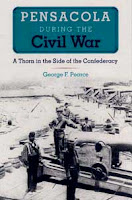
Pensacola during the Civil War: A Thorn in the Side of the Confederacy

by George F. Pearce

From the publisher:
"A pathbreaking study of one of the forgotten enclaves of the Civil War. . . . [It] opens new understanding of the role of Fort Pickens and Pensacola and the onset of the Civil War." -- B. F. Cooling, author of Forts Henry and Donelson: Key to the Confederate Heartland

Well before the outbreak of the Civil War, both North and South recognized the strategic importance of Pensacola, Florida’s largest city in 1861. Bruce Catton has characterized nearby Fort Pickens, on the northwestern Gulf Coast, as "a case that was fully as explosive as that of Fort Sumter." Until this new work by George Pearce, however, historians have neglected Pensacola’s role in the secession crisis and the conflict that ensued.

This straightforward narrative account begins with the secession movement and the Fort Pickens truce, then follows the course of events in this forgotten corner of the war. From the secessionist capture of Pensacola's navy yard and hospital and Forts Barrancas and McRee in February 1861, to Bragg’s failed raid on Fort Pickens, to the operations of the East and West Gulf Blockading Squadrons creating unrest along the coast, Pearce follows the actions by which the Union denied Confederate resupply by sea and tied down a considerable Confederate force that was increasingly needed elsewhere. He details Union cavalry raids as far north as Alabama, which disrupted vital rail transportation between Mississippi and Georgia, and the defeat of the Confederates at Blakely, which forced the surrender of Mobile.

Pearce also follows the impact of the war on Pensacola itself. Coping with white refugees, freed slaves, scorched-earth evacuations, raiding and foraging by the military, and the constant presence of Union and Confederate troops led to the abandonment of the city. By July 1863, a once vibrant population had dwindled to 72 whites and 10 blacks, and the scars of conflict gave this antebellum metropolis a ghostly appearance.

Illustrated with maps and period photos and drawings, this first examination of Pensacola's forgotten role in the Civil War will appeal to both Civil War buffs and those interested in the history of the Gulf Coast from Pensacola to the Rio Grande.

George F. Pearce, professor emeritus of history at the University of West Florida in Pensacola, is the author of The U.S. Navy in Pensacola: From Sailing Ships to Naval Aviation, 1825-1930 (UPF, 1980).

Soldier Boy: The Civil War Letters of Charles O. Musser, 29th Iowa

by Barry Popchock

From the publisher:
Blood and anger, bragging and pain, are all part of this young Iowa soldier's vigorous words about war and soldiering. A twenty-year-old farmer from Council Bluffs, Charles O. Musser was one of the 76,000 Iowans who enlisted to wear the blue uniform. He was a prolific writer, penning at least 130 letters home during his term of service with the 29th Iowa Volunteer Infantry.

Soldier Boy makes a significant contribution to the literature of the common soldier in the Civil War. Moreover, it takes a rare look at the Trans-Mississippi theater, which has traditionally been undervalued by historians.

Always Musser dutifully wrote and mailed his letters home. With a commendable eye for historical detail, he told of battles and marches, guerrilla and siege warfare, camp life and garrison soldiering, morale and patriotism, Copperheads and contraband, and Lincoln's reelection and assassination, creating a remarkable account of activities in this almost forgotten backwater of the war.

Raising Freedom's Child: Black Children and Visions of the Future After Slavery

by Mary Mitchell

From CWBN:
”Mitchell's sophisticated, nuanced reading of a wealth of previously untapped documents and period photographs casts a dazzling fresh light on the way that abolitionists, educators, missionaries, planters, politicians, and free children of color envisioned the status of African Americans after emancipation.” — Steven Mintz, University of Houston

“Raising Freedom’s Child demonstrates the importance of childhood studies for understanding the nation’s political, economic, and social history. In this carefully researched book, Mitchell keeps the black child at the center of the struggle to define freedom in the aftermath of Civil War and emancipation.” — Marie Jenkins Schwartz, University of Rhode Island

The end of slavery in the United States inspired conflicting visions of the future for all Americans in the nineteenth century, black and white, slave and free. The black child became a figure upon which people projected their hopes and fears about slavery’s abolition. As a member of the first generation of African Americans to grow up in freedom, the black child — freedom’s child — connoted a future where African Americans might enjoy the same privileges as whites: landownership, equality, autonomy. Yet this image was a nightmare for most white southerners. Even many northerners expressed doubts about the consequences of abolition for the nation and its identity as a “white” republic.

From the 1850s and the Civil War to emancipation and the official end of Reconstruction in 1877, Raising Freedom’s Child examines slave emancipation and opposition to it as a far-reaching, national event with profound social, political, and cultural consequences. Mary Niall Mitchell analyzes a dizzying array of representations of the black child—letters, photographs, newspaper columns, court cases, and more—to illustrate how Americans contested and defended slavery, tracing sharp debates over black children’s education, labor, racial classification, and citizenship. Only with the triumph of segregation in public schools in 1877 did the black child lose its public role in the national struggle over civil rights, a role it would not play again until the 1950s.

Friday, February 29, 2008

Vital Rails: The Charleston & Savannah Railroad and the Civil War in Coastal South Carolina

by H. David, Jr. Stone

From the publisher:
Completed in 1860 and spanning more than one hundred miles across rice fields, salt marshes, and seven rivers and creeks, the Charleston & Savannah Railroad was designed to revolutionize the economy of South Carolina's lowcountry by linking key port cities. With the onset of the Civil War, the railroad became an integral part of the Confederacy's military, economic, and communications efforts along the coast and a frequent military objective of Union assaults. In Vital Rails, H. David Stone, Jr., provides the first detailed recounting of the C&S line's history and of the railroad's valuable role in the Civil War.

Originally conceived as a means to stave off commercial isolation in Charleston and Savannah by placing the cities on the shortest trade route between the Northeast and the Gulf Coast, the C&S was chartered by a coalition of lowcountry planters, merchants, and politicians. Construction was aided by state government funding and completed by crews of slaves just prior to the onset of war. Following the Union capture of Port Royal in November 1861, the railroad's importance became not only economic but also logistical as a communications line and troop transport for the Confederacy. From November 1861 to March 1862, while commanding coastal forces, General Robert E. Lee supervised construction of the line's fortifications and situated his headquarters near it at Coosawhatchie in Beaufort District.

The railroad was essential in containing Union attacks on Charleston after the capture of Beaufort. In total the C&S was the objective of eight battles and skirmishes with Union forces--including the Battles of Pocotaligo in May and October of 1862 and the Battle of Honey Hill in November 1864. It was not until General William T. Sherman's army took Savannah in December 1864 that the Union forces had the strength to mount a successful campaign against the railroad.

Left in financial ruin after the war, the C&S faced a series of bankruptcies before its route's eventual incorporation into one of the most important commercial transportation arteries on the eastern seaboard, the Plant System, later the Atlantic Coast Line, the Seaboard Coast Line, and finally CSX Transportation. In mapping this first full history of the railroad, Stone has arduously sifted through company records, annual reports, and other public and private documents to record fully the story of the C&S and of the men--including William J. Magrath, R. L. Singletary, and Henry S. Haines--who managed it during wartime with resourcefulness and a strong sense of their role in defending South Carolina.

Vital Rails is an excellent study that expertly connects the importance of the Charleston & Savannah Railroad to the Confederacy's overall war effort. Rich with detailed information, maps, and images, Stone's book is a must-read for all those interested in truly understanding the crucial logistical and military operations in the South Carolina lowcountry during the Civil War.--Stephen R. Wise, curator, Parris Island Museum, and author of Gate of Hell: Campaign for Charleston Harbor, 1863

H. David Stone breaks new ground in his thoughtful study of the Charleston & Savannah Railroad. The C&S's conception, construction, Civil War operations, and economic collapse at the end of the war describe in microcosm antebellum southern railroad development. The Confederate defense of the railroad against Union raiders offers new insights into this nearly forgotten aspect of the Civil War. A well-researched history, Vital Rails should attract the interest of economic, military, railroad, and southern historians as well as those interested in the histories of Charleston and Savannah.--John E. Clark, Jr., author of Railroads in the Civil War: The Impact of Management on Victory and Defeat


From CWBN:
Highly recommended. Stone's pours Civil War history and railroad history into a narrative mold, adding plenty of detail for buffs of both camps. Guaranteed to improve your understanding of the role of rail power in the ACW.

Slavery, Capitalism and Politics in the Antebellum Republic: Volume 2, The Coming of the Civil War, 1850-1861

by John Ashworth

From the publisher:
This book asks why the United States experienced a civil war in 1861 and analyses the descent into war in the final decade of peace. The book systematically surveys southern extremists, Republicans, Democrats, Whigs, temperance advocates and Know Nothings. It advances a new and unique explanation of the origins of the Civil War, the most important event in the history of the most powerful country in the world.

John Ashworth was born in Lancashire, England, and studied at the Universities of Lancaster and Oxford. He is currently Professor of American History in the School of American and Canadian Studies at the University of Nottingham. Professor Ashworth is the author of 'Agrarians' and 'Aristocrats': Party Political Ideology in the United States, 1837-1846, of Slavery, Capitalism and Politics in the Antebellum Republic: Volume 1: Commerce and Compromise, 1820-1850 (both of which were published by Cambridge University Press), and of numerous articles and reviews in learned journals.

Two Boys in the Civil War: Confederate Brothers During and After the War Between the States

by William Houghton

From the publisher:
Two Boys in the Civil War recounts the war stories of William, an eighteen-year-old schoolteacher at Smith's Station, Alabama, and his brother Mitchell, a sixteen-year-old assistant newspaper editor in Newton, Alabama.

William enlisted in 1861 and was wounded seven times in battle. Mitchell, who also enlisted in 1861, was twice wounded, captured at Lookout Mountain, and imprisoned for sixteen months at Camp Morton, Indiana, where he nearly died from starvation and exposure.

A Soldier to the Last: Maj. Gen. Joseph Wheeler in Blue and Gray

by Edward G. Longacre

From the publisher:
Maj. Gen. Joseph Wheeler served in two armies, playing a major role in the development of Confederate cavalry in the Civil War's western theater, and, more than thirty years afterwards, commanded troops in the Spanish-American War. After leaving the U.S. Army to join the Confederacy, Wheeler served in artillery and infantry units before joining the cavalry. Subsequently, he fought at Shiloh, the Battle of Murfreesboro, and other engagements. As a cavalry commander in the Army of Tennessee from mid-1862 almost to the war's end, he raided Gen. William T. Sherman's lines of communication and contested his advance in the final Carolinas campaign.

In addition to detailing Wheeler's Civil War experience, Edward Longacre discusses Wheeler's youth and education at West Point, his pre-Civil War service in the Regiment of Mounted Riflemen, his postwar business, his political career as a congressman from Alabama, and his colorful service in Cuba as a major general of volunteers during the Spanish-American War. Longacre also seeks to correct errors and misconceptions about this Civil War figure that have become a part of the public record, making Joseph Wheeler's life and career accessible to a new generation of readers. A Soldier to the Last will be a valuable addition to the library of anyone interested in Civil War history and U.S. military history.

Appalachian Ohio and the Civil War, 1862–1863

by Susan G. Hall

From the publisher:
The antebellum culture of Harrison County (birthplace of George Armstrong Custer) and the surrounding five-county area of Appalachian east Ohio was an outspoken, democratic society—and a way station of the Underground Railroad for escaping slaves. With the coming of the War Between the States, this community faced momentous change and bitter divisions. Its politicians stumped for and against the conflict; its farmboys, carpenters, scholars and ministers marched off to Kentucky, Mississippi, Virginia, and Tennessee, there to become hardened soldiers laying destruction about them, even as a powerful Copperhead peace movement grew at home. The area was menaced by John Hunt Morgan’s Confederate Cavalry.

This narrative history of the crucial year of this area’s real involvement in the war, from summer to summer, provides a portrait of the area’s Scotch-Irish, followed by German and English, traditions and culture, and the ways in which the war affected everyone, young women left without husbands and whole families plagued by far-away diseases brought home. Letters and diaries from the soldiers and those who loved them provide insight into their thoughts and feelings, as well as their reactions to the very different cultures (women in white dresses had not been seen before) they experienced. Also included are illustrations and maps that display both the Harrison County area and the battlefields where many of her sons saw combat.

Former college professor Susan G. Halllives in Louisville, Kentucky. In addition to writing on Appalachia and the Civil War, she coedited the Encyclopedia of American Icons.

The Antietam Campaign

by Gary W. Gallagher

From the publisher:
The Maryland campaign of September 1862 ranks among the most important military operations of the American Civil War. Crucial political, diplomatic, and military issues were at stake as Robert E. Lee and George B. McClellan maneuvered and fought in the western part of the state. The climactic clash came on September 17 at the battle of Antietam, where more than 23,000 men fell in the single bloodiest day of the war. The essays in this volume address a range of topics related to Lee's and McClellan's operations. Approaching their subjects from a variety of perspectives, contributors explore questions regarding military leadership, strategy, and tactics, the impact of the fighting on officers and soldiers in both armies, and the ways in which participants and people behind the lines reacted to, interpreted, and remembered the campaign. The contributors are William A. Blair, Keith S. Bohannon, Peter S. Carmichael, Gary W. Gallagher, Lesley J. Gordon, D. Scott Hartwig, Robert E. L. Krick, Robert K. Krick, Carol Reardon, and Brooks D. Simpson.

From CWBN:
This is the paperback release of a previously published hardback title.

Wednesday, February 27, 2008

Manhood and Patriotic Awakening in the American Civil War: The John E. Mattoon Letters, 1859-1866

by Robert Donald

From the publisher:
It has been over sixty years since the first book that tried to explain the life and lot of the common soldier in the American Civil War was published. Since Bell Wiley's Life of Johnny Reb (1943), there have been many thousands of pages devoted to the troops and the social history underlying the conflict of the Civil War. Within that historical record, one question still captivates and provokes: why did they fight?

John E. Mattoon was certainly one such "common" soldier, aside from his uncommonly interesting and expressive letters. This book constitutes a valuable case study illuminating the motives, experiences, and ultimate realizations of a young cavalry volunteer. The exploration of John's personal motivations and the actions of his peers adds further clarity to our body of knowledge, which may force us to reassess some preconceived notions about the prototypical Union soldier. Scholarly research adds historical context to provide colorful depth and flesh to a developing interpretation of John's experiences. A refreshing approach to an old conflict-students, teachers, and anyone interested in the personal side of war will benefit from the firsthand glimpse of Manhood and Patriotic Awakening.

Robert Bruce Donald is a graduate of Middlebury College in Vermont and earned his Master's Degree in History from Trinity College (Hartford). He has worked in finance and marketing, then as a consultant producing a multitude of documents over many years. But it is a life-long interest in the study of history that has happily produced this book.

Tuesday, February 26, 2008

Dispatches for the New York Tribune: Selected Journalism of Karl Marx

by Karl Marx

From the publisher:
A compelling, wide-ranging collection of Karl Marx's journalism—available only from Penguin Classics

Karl Marx is arguably the most famous political philosopher of all time, but he was also one of the great foreign correspondents of the nineteenth century. Drawing on his eleven-year tenure at the New York Tribune (which began in 1852), this completely new collection presents Marx's writings on an abundance of topics, from issues of class and state to world affairs. Particularly moving pieces highlight social inequality and starvation in Britain, while others explore his groundbreaking views on the slave and opium trades. Throughout, Marx's fresh perspective on nineteenth-century events reveals a social consciousness that remains inspiring to this day.

Monday, February 25, 2008

Freedom for Themselves: North Carolina's Black Soldiers in the Civil War Era

by Richard M. Reid

From the publisher:
More than 5,000 North Carolina slaves escaped from their white owners to serve in the Union army during the Civil War. In Freedom for Themselves Richard Reid explores the stories of black soldiers from four regiments raised in North Carolina. Constructing a multidimensional portrait of the soldiers and their families, he provides a new understanding of the spectrum of black experience during and after the war.

Reid examines the processes by which black men enlisted and were trained, the history of each regiment, the lives of the soldiers' families during the war, and the postwar experiences of the veterans and their families living in an ex-Confederate state. By considering four regiments from a single state, Reid presents a cross section of a wide range of experiences and assesses what experiences proved largely universal among black troops. The full freedom they fought for and dreamed of having when the war ended did not materialize in their lifetimes, but Reid shows that many of them found in the army a kind of equality that was denied them in civilian life. The postwar benefits afforded to white veterans seldom crossed the color line. The accolades African American soldiers received, Reid demonstrates, came not from a new southern society, but from within their own communities, where black soldiers were seen and recognized as heroes.

The Civil War in Loudoun County, Virginia: A History of Hard Times

by Stevan F. Meserve

From the publisher:
In this look at Loudoun County's role in the Civil War, historian Stevan Meserve narrates not only the large-scale fighting at Ball's Bluff in 1861 and in the Loudoun Valley cavalry battles of 1863, but also the lives of the citizens who sacrificed their crops and livestock, cared for the wounded and buried the dead of storied regiments such as White's Comanches, Cole's Potomac Home Brigade, Mosby's Rangers and the Independent Loudoun Rangers. Drawing upon military accounts and other historical documents, The Civil War in Loudoun County celebrates their eventual triumph and the vibrant communities that exist today.

From CWBN:
Barnes& Noble shows the release date for this title as today; Amazon shows it as March 14.

The Battle of Belmont: Grant Strikes South

by Nathaniel Cheairs Hughes

From the publisher:
The battle of Belmont was the first battle in the western theater of the Civil War and, more importantly, the first battle of the war fought by Ulysses S. Grant. It set a pattern for warfare not only in the Mississippi Valley but at Fort Donelson and Shiloh as well. Grant's 7 November 1861 strike against the Southern forces at Belmont, in southeastern Missouri on the Mississippi River, made use of the newly outfitted Yankee timberclads and all the infantry available at the staging area in Cairo, Illinois.

The Confederates, led by Leonidas Polk and Gideon Pillow, had the advantages of position and superior numbers. They hoped to smash Grant's expeditionary force on the Missouri shore and cut off the escape of the Illinois and Iowa troops from their boats. The confrontation was a bloody, all-day fight that a veteran of a dozen major battles would later call "frightful to contemplate." At first successful, the Federals were eventually driven from the field and withdrew up the Mississippi to safety. The battle cost some twenty percent of his troops, but as a result of this engagement he became known as an audacious fighting general.

Using diaries and letters of participants, official documents, and contemporary newspaper accounts, Nathaniel Hughes provides the only full-length tactical study of the battle that catapulted Grant into prominence. Throughout the narrative, Hughes draws sketches of the lives and fates of individual soldiers who fought on both sides, especially of the colorful and enormously dissimilar principal actors, Grant and Polk.

Fredericksburg Campaign: Decision on the Rappahannock

by Gary W. Gallagher

From the publisher:
"It is well this is so terrible! We should grow too fond of it," said General Robert E. Lee as he watched his troops repulse the Union attack at Fredericksburg on 13 December 1863.

This collection of seven original essays by leading Civil War historians reinterprets the bloody Fredericksburg campaign and places it within a broader social and political context. By analyzing the battle's antecedents as well as its aftermath, the contributors challenge some long-held assumptions about the engagement and clarify our picture of the war as a whole. The book begins with revisionist assessments of the leadership of Ambrose Burnside and Robert E. Lee and features a portrait of the conduct and attitudes of one group of northern troops who participated in the failed assaults at Marye's Heights. Other essays examine how both armies reacted to the battle and how the northern and southern homefronts responded to news of the carnage at Fredericksburg. A final chapter explores the impact of the battle on the residents of the Fredericksburg area and assesses changing Union attitudes about the treatment of Confederate civilians.

Wednesday, February 20, 2008

On Sherman's Trail: The Civil War's North Carolina Climax

by Jim Wise

From CWBN:
We were unable to find any description of this book on the publisher's website or on the sites of booksellers Amazon and Barnes & Noble.

There is also a discrepancy in publication date, with B&N showing a February 16 release, Amazon showing a March 14 release, and the publisher's site making no mention of the title at all.